Your first tandem skydive is roughly a three-hour day containing about sixty seconds that you'll remember for the rest of your life. This is the honest sequence: what actually happens, in order, including the parts the marketing videos skip and the one instruction that matters more than everything else combined.
Before You Book: Three Gates
You must be 18. In the US this is absolute, it's in USPA's Basic Safety Requirements and in the tandem manufacturers' own manuals. There is no parental-consent workaround.
There's a weight limit. Most DZs cap tandem students around 220–230 pounds, often with a surcharge above a threshold. It's set by the tandem system's certified maximum all-up weight, and it isn't negotiable at the counter.
You'll disclose your health. The medical questionnaire screens for heart and respiratory conditions, prior shoulder dislocations, joint problems, fainting, recent surgery, and pregnancy. Answer it honestly, it exists to keep you out of a harness that would hurt you.
The Real Timeline
| Phase | How long |
|---|---|
| Check-in, waiver, medical questionnaire | 30–60 min (arrive 1–2 hours before your slot) |
| Gear-up | ~15 min |
| Briefing | 10–15 min |
| Climb to altitude | 15–20 min |
| Freefall | About 60 seconds from 13,500 ft, the standard tandem altitude |
| Under canopy | 4–6 minutes |
| Landing, unclipping, debrief | 15 min |
One number to get right, since it's misreported constantly: freefall time scales with exit altitude, and it is measured in seconds, not minutes. From 10,000 feet you get roughly 30 seconds. From 13,500–14,000, where most tandems exit, you get 45 to 60. Nobody in the history of the sport has had a five-minute freefall.
Gear-Up
Your instructor starts you in a harness: webbing around your torso, shoulders, and legs, adjusted snug enough to feel slightly aggressive. That snugness is the point.
You'll be connected to your instructor at four harness attachment points: two upper D-rings under the large harness rings at your shoulders, and two lower D-rings on the laterals at your hips. Get the terminology right, because a lot of published guides call this a "bridle system", a bridle is something else entirely (it's the line running from the drogue to the deployment bag). And the four points are not four redundant copies of one connection: all four are load-sharing and all four are required. Your instructor will check every one of them, twice, and again in the aircraft.
Then a jumpsuit, goggles, and, here's a small surprise, probably not a hard helmet. USPA's student equipment requirements explicitly exempt tandem students from the rigid-helmet rule, and tandem manufacturers generally prohibit them: a hard shell on your head sits inches from your instructor's face during exit and opening. Most DZs issue a soft leather "frap hat," and some issue nothing. Likewise, you probably won't wear an altimeter, your instructor wears one, and altitude is their job on this jump.
The Briefing
Ten or fifteen minutes covering the sequence, your body position, and what to do if things go wrong. You aren't executing emergency procedures, your instructor is, but understanding the system quiets the part of your brain that's arguing with you.
You'll learn the arch: hips forward, head back, arms crossed on your chest for exit, then out and relaxed once your instructor taps you. You'll rehearse the exit position. And you'll be told the landing instruction, which we'll come back to, because it's the one thing you're actually responsible for.
On safety, you'll get numbers rather than reassurance, and the numbers are genuinely good. USPA recorded 16 civilian skydiving fatalities in 2025 across an estimated 3.47 million jumps, about 0.46 per 100,000. In 2024 it was 9 fatalities across 3.88 million jumps, the lowest rate on record. Tandem specifically is safer still: USPA's decade figure works out to roughly one student fatality per 500,000 tandem jumps. Your instructor holds a rating that required 500 jumps, three years in the sport, a USPA D license, and an FAA medical certificate.
The Aircraft and the Exit
You'll climb into a jump plane (a Twin Otter, Caravan, King Air, or a Cessna 182 at a smaller DZ), stripped of seats except for a bench along the fuselage. It's cold, loud, and too noisy for conversation. You'll sit on your instructor's lap, clipped in, which is exactly as unglamorous as it sounds.
At altitude the door opens and the noise doubles. Here's how the exit actually works, because you may have read otherwise: you do not step out onto a wing strut. That's a solo static-line student procedure. A tandem pair is rigidly connected at four points and cannot climb anywhere. On turbine aircraft you'll scoot down the bench to a large aft door, and on your instructor's command you'll cross your arms, put your head back on their shoulder, and place your feet outside or under the aircraft, and then you simply fall out of the door.
The first few seconds are pure sensory overload. Wind, cold, and a stomach doing something entirely new. Your brain can't decide between terror and delight and settles on both. People scream, laugh, or make a sound they've never made before. All of it is normal.
The Drogue: The Thing Nobody Tells You About
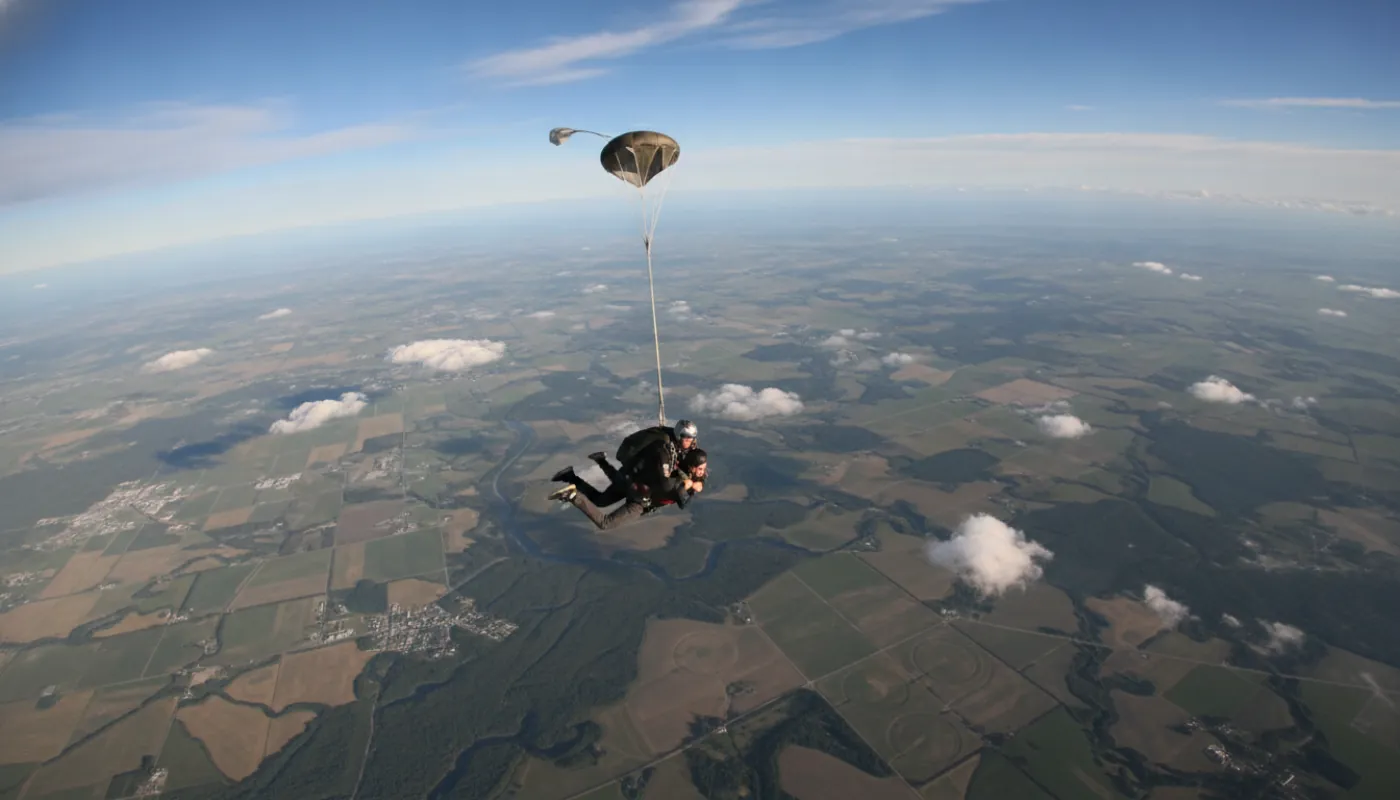
Seconds after exit, your instructor throws a small chute called a drogue, and it is the single most important piece of equipment on the jump.
Two people falling together are heavy, and without a drogue a tandem pair would reach roughly 175–200 mph, far too fast to safely open a parachute. The drogue acts as an air brake, holding you at a normal skydiving speed of about 120 mph and keeping the pair stable and belly-down.
It's also why your instructor deploys the main and you don't: the main deployment is triggered by releasing the drogue, and both drogue-release handles are on the instructor's rig. On a tandem, you deploy nothing. Your job is to arch and enjoy it.
Freefall
About sixty seconds, and they do not feel like sixty seconds.
You can breathe normally, this is the first-timer myth worth killing. There's plenty of air, and no mechanism by which you'd suffocate. The sensation is unfamiliar rather than difficult: air is moving past you fast, and if you gasp against it, it feels strange. Breathe through your nose or just relax your jaw and it sorts itself out in a few seconds.
The ground doesn't rush at you. From 13,000 feet the world is too far away to read as approaching: it's a map, abstract and enormous, and the horizon is flat (you are not, whatever else you may read, anywhere near the edge of space). Most people's memory of freefall comes back fragmented: the cold, the roar, a color, a feeling. That's normal too.
Deployment and the Canopy Ride
Your instructor deploys at around 5,000–6,000 feet. That floor is not arbitrary: USPA's Basic Safety Requirements set 5,000 feet AGL as the minimum container opening altitude for tandem jumps: considerably higher than the 3,000 feet required for solo students and 2,500 for licensed jumpers. Tandems open high on purpose.
The opening is firmer than people expect: a solid, decelerating tug, occasionally enough to knock the breath out of you. Then the roar stops. You're sitting in a harness in silence, four minutes from the ground, under a canopy of about 360–400 square feet, roughly the footprint of a two-car garage, and more than double what a sport skydiver flies.
This is when the experience actually lands. Your instructor may spiral to burn altitude, or fly straight and let you look. Many people cry here. Not from fear, from the specific realization that they did something irreversible and are still here.
Landing: The One Thing You Have to Do
Everything up to now, your instructor has handled. This part is yours.
On your instructor's command, lift your legs straight out in front of you and hold them up. Do not reach for the ground. Do not try to run. The standard tandem landing is a controlled slide-in on your backside, with your legs up and out of the way.
This is not a stylistic preference. The large majority of tandem injuries come from students who put their feet down when they were told to lift their legs. Your instructor's legs are landing this parachute; yours are cargo. In brisker winds you may stand it up instead, they'll tell you which, on final.
Then you're down. Your instructor unclips you, someone takes your goggles, and the accumulated intensity of the last hour hits you all at once. You'll walk back on rubber legs with a wind-burned face and a grin you can't turn off.
Afterward
There'll be a debrief, a certificate, and, if you bought it, video. Most people announce they want to go again immediately. Some of them mean it.
If you do: the next step is AFF, the training path to your own license. Start at the DZ that took you up, and read our comparison of tandem and AFF before you commit.
And the last thing worth saying: you will be nervous. Everyone is, including the instructor's fourth tandem of the day. The paperwork, the briefing, the gear checks, the repetition, the whole ritual exists to walk you from fear into trust in a system that has been refined over forty years and works. Show up, listen, arch, and lift your legs.