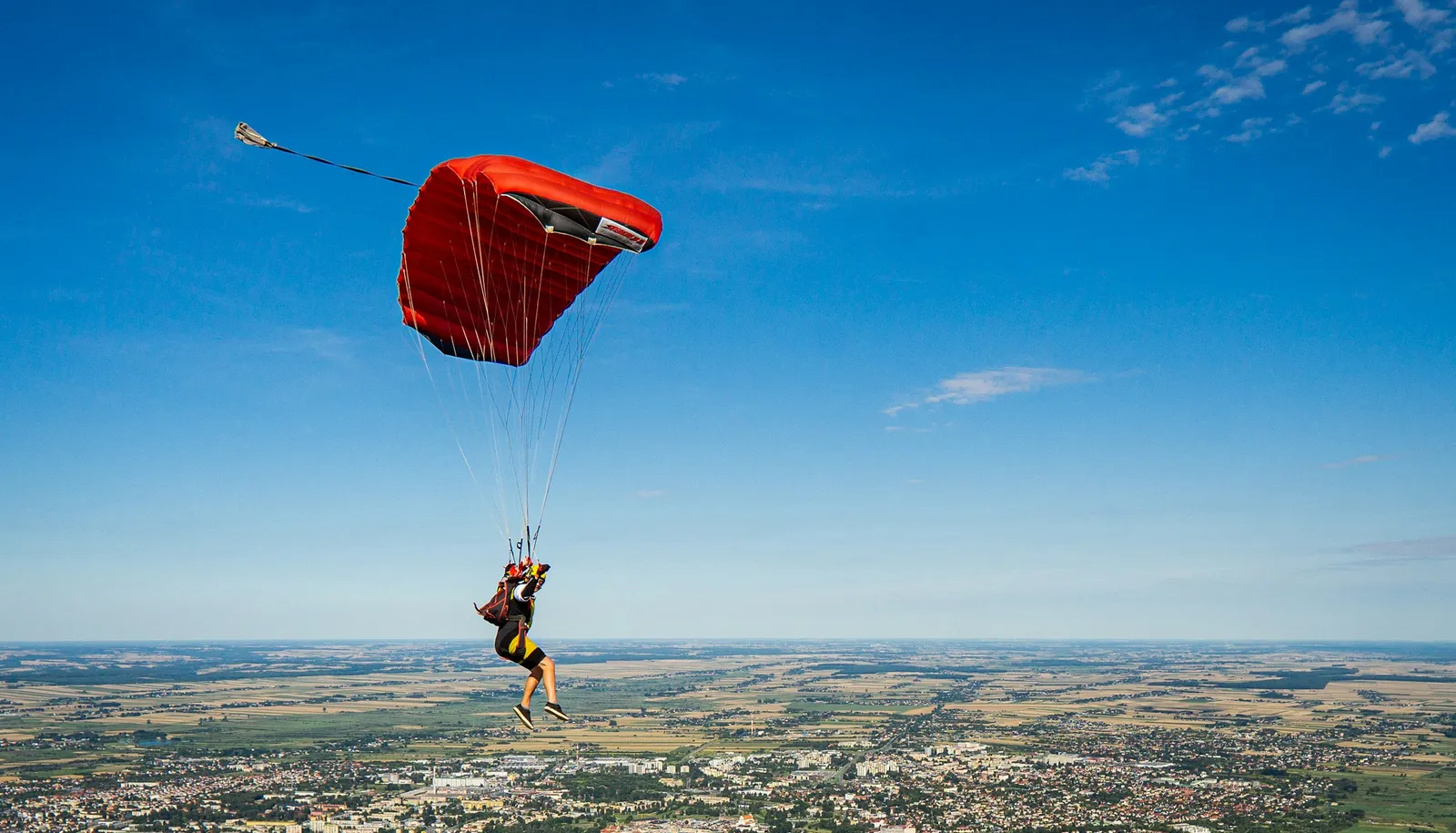
The B-license proved you can fly a canopy on purpose. The C-license asks whether you can do it precisely, every time, and whether you have the experience to start teaching other people.
That second part is the real point. C is the license that makes you eligible for USPA Instructor ratings. Everything in its requirement list is there to make sure the person standing in front of a first-jump student has actually done the work.
Here's what USPA requires, and what you get for it.
What USPA Actually Requires
These come straight from the Skydiver's Information Manual (SIM Section 3-1). They're the same at every USPA drop zone.
| Requirement | The specifics |
|---|---|
| Membership | Current USPA member in good standing |
| Prerequisite | Hold a B-license, or meet all current B-license requirements |
| Total jumps | 200 |
| Accumulated freefall time | At least 60 minutes of controlled freefall |
| Accuracy landings | 25 landings within 7 feet (2 meters) of target center |
| Formation skydives | 50 formation skydives or 50 formation freefly skydives, at least 10 of them with four or more participants |
| Written exam | Pass the USPA C-License Exam with 75% or better |
The exam is conducted by a current USPA Instructor, S&TA, Examiner, Judge or board member. It's closed book: no references, no help. And to qualify for a higher license you must have passed every lower license exam too, so a skipped B exam comes back to find you here.
The Accuracy Standard Is the Whole Story
At B, you needed 10 landings within 33 feet. At C, you need 25 within 7 feet.
That isn't a small step. A 33-foot circle forgives a pattern that's a little long or a flare that's a little early. A 7-foot circle doesn't. You need a consistent pattern, an honest read of the wind on every approach, and a final leg you can adjust with small inputs instead of a desperate turn near the ground.
The jumpers who struggle with this requirement usually have the same habit: they fly a different approach every time and hope to land close. The ones who get it fly the same pattern at the same checkpoints, notice what the wind did to them, and correct earlier.
Don't chase the target low. A hard turn at low altitude to save an accuracy landing is exactly the habit this license exists to train out of you. Miss the circle and log the next one instead.
Formation: Fifty Jumps, Ten of Them Bigger
Fifty formation skydives, belly or freefly, with at least 10 involving four or more people.
The B-license asked for 10 formation jumps. C asks for five times that, and the four-way minimum is the meaningful part. A bigger group means more people to track, more planning on the ground, and a breakoff where more bodies need clean air. That's the experience the license wants you to have before you're responsible for someone else in freefall.
The practical route is the one most jumpers take anyway: jump with organizers, join four-ways, and say yes when a group needs a body. Fifty formation jumps out of 200 total is a quarter of your jumping, so if you've spent your first 150 jumps solo, this is the requirement that will set your pace.
The Freefall Minimum
Sixty minutes of controlled freefall by 200 jumps. A full-altitude jump gives you roughly a minute, so most jumpers who mostly jump from altitude meet it without thinking.
Where it bites is a logbook heavy on hop-and-pops or low-altitude canopy work. If that's you, count your freefall time early rather than discovering at jump 200 that you're short.
What the C-License Actually Unlocks
USPA lists the privileges in one sentence: all B-license privileges, eligibility for USPA Instructor ratings except Tandem, and participation in certain demonstration jumps. The Basic Safety Requirements (SIM Section 2-1) add a few practical changes.
Instructor ratings (except Tandem). This is the big one. C makes you eligible to pursue Instructor ratings. Each rating course has its own prerequisites on top of the license, so ask your S&TA or a course director what the one you want requires. Tandem Instructor is the exception and sits beyond C.
Lower opening altitude, by waiver. Like B-license holders, C and D holders have a 2,500-foot minimum opening altitude. For C and D, the SIM spells out that it can be waived down to no lower than 2,000 feet.
Planned breakaway jumps. Pre-planned breakaway jumps are limited to C- and D-license holders using FAA TSO'd equipment.
Certain demonstration jumps. C opens some demo jumps. The tighter Level 2 demo areas require a D-license plus a USPA PRO Rating for every jumper, so don't read C as a ticket to stadium shows.
What doesn't change. Your landing-area margin stays where it was at B: at least 165 feet from the nearest hazard. That doesn't drop until D, where it's 40 feet.
Wingsuit isn't a C privilege. It's gated by jump numbers, not license: 200 skydives plus a current license. Since C also requires 200 jumps, the two tend to arrive at the same time, and people confuse them. You could hold a B with 200 jumps and be wingsuit-eligible, or hold a C and choose not to fly one.
How to Apply
USPA's own advice is to talk to a USPA Instructor first. They'll tell you which documents the application needs, how to submit it and how to pay. USPA prefers that instructors verify your requirements and set up the exam online.
Practically, that means your logbook has to show the work. Log your accuracy landings and formation jumps as you make them, with the details your DZ asks for, instead of trying to reconstruct 25 accuracy jumps from memory at the end.
One more rule worth knowing: your license is only valid while you're a current USPA member. Let your membership lapse and the license lapses with it.
How Long It Takes
There's no honest single number. The gap from B to C is 150 jumps, which is a season or two for a weekend regular and longer for anyone who jumps a few times a month. Weather, money and distance to the DZ matter more than talent.
The requirement most likely to slow you down is the one you've neglected. For solo jumpers that's formation. For people who land wherever the canopy takes them, it's the 7-foot accuracy. Look at your logbook now, find the gap and start on it.
If you haven't finished B yet, start with our B-license guide. For the whole ladder from A to D in one place, see the USPA license overview.