You've got your A-license. You can jump without supervision, pack your own main, and fly with other people. So what is the B-license actually for?
Two things. It's the license that finally forces you to become a canopy pilot instead of a passenger under a good parachute, and it's the gate to the USPA Coach rating and, further out, to the disciplines everybody actually wants. It's also the license most commonly bungled, because half the guides on the internet list the flashy requirements and quietly omit two mandatory ones. Applications get bounced over exactly that.
Here's the real list.
What USPA Actually Requires
Every one of these is required. Not "recommended," not "DZ-dependent", these are the USPA license requirements (SIM Section 3-1), and they're uniform across every drop zone in the country.
| Requirement | The specifics |
|---|---|
| Total jumps | 50 |
| Accumulated freefall time | At least 30 minutes of controlled freefall |
| Accuracy landings | 10 landings within 33 feet (10 meters) of target center |
| Formation skydives | 10 formation jumps, belly-flying (FS) or freeflying (FF), with at least 5 involving three or more participants |
| Water training | Live water-landing training with full equipment |
| Canopy Piloting Proficiency Card | Every item completed and the card signed by a current USPA S&TA, Examiner, or board member |
| Written exam | Pass the written USPA B-License Exam (75% to pass), given by a current USPA Instructor, S&TA, Examiner, Judge, or board member |
The Two Everybody Forgets
The B-License Canopy Piloting Proficiency Card. This is the requirement that trips people up, and it's the most valuable thing in the license. It's a structured set of canopy drills (flat turns, flare practice at altitude, braked approaches, accuracy work), that you complete and get signed off. Your B-license application must include the completed, signed card. No card, no license. Get it early and work it deliberately; it is, by a wide margin, the best free canopy curriculum you will ever be handed, and it exists because canopy flight is what hurts jumpers.
The written exam. Yes, there's a test. Some guides flatly state that B is "a hands-on demo, not a written sign-off." That is wrong. Study, take it, pass it.
Formation Skydiving
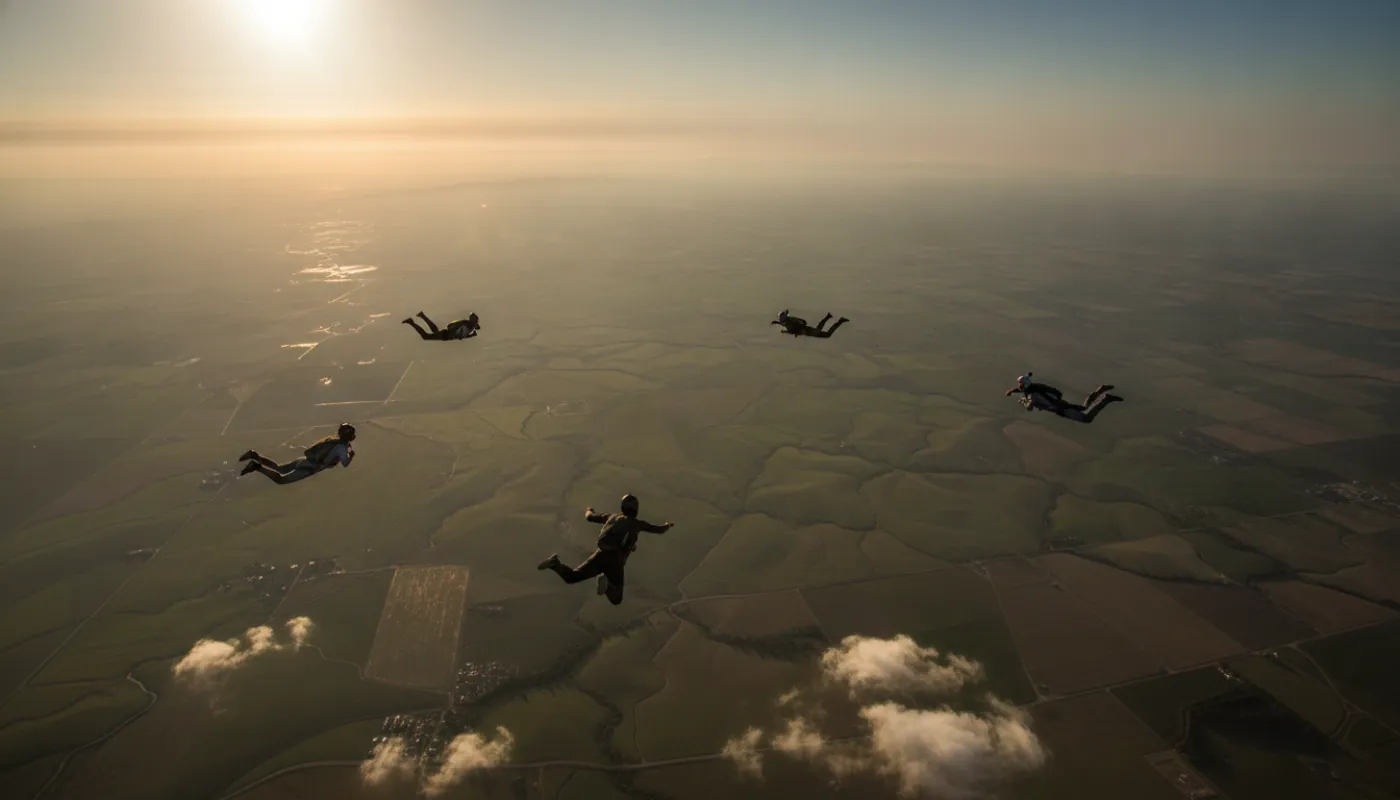
Ten formation jumps, five of them with three or more people. This is where you stop treating the sky as empty space.
One correction worth making loudly, because it's a common piece of internet nonsense: your early formation jumps are belly-to-earth, not head-down. Belly flying (FS) is the foundational orientation and where coached novice formation work starts, typically with a 2-way alongside a coach. Head-down is an advanced freefly orientation. Anyone telling a 50-jump skydiver that their first formation jumps will be head-down is describing a jump you should not be on.
The real skill in formation isn't holding the dock, it's leaving it. Breakoff is when the group separates so everyone has clean air to deploy into, and USPA sets the margins by group size:
| Group size | Breakoff altitude |
|---|---|
| 5 or fewer | At least 1,500 feet above the highest planned deployment altitude |
| 6 or more | At least 2,000 feet above the highest planned deployment altitude |
Note what that is: a vertical margin above your opening altitude, not a horizontal distance. Track flat, track hard, and look before you wave off. By your tenth formation jump, breakoff should be the part you never think about, which is precisely when it's working.
Canopy Accuracy
Ten landings inside a 33-foot (10-meter) circle. That sounds generous until you try to do it on demand, in shifting wind, ten separate times.
The mechanics are ones you already own: a disciplined pattern, honest wind reading, a smooth full flare. What accuracy adds is consistency: the same setup, the same pattern altitudes, the same flare, jump after jump. It rewards deliberate flying and punishes improvisation, which is exactly the habit the license is trying to build in you before you start downsizing.
Fly the same approach every time in every condition. When you can put the canopy where you said you would ten times running, you're a pilot.
Water Training
Live water-landing training, with full equipment. You'll get in the water in a harness and rehearse the unintentional-water-landing drill: disconnecting, clearing the canopy, staying afloat. It's the one requirement with nothing to do with freefall or canopy piloting and everything to do with surviving the worst off-DZ scenario near a lake, a river, or a coast. It's a hands-on session, not a signature.
Worth knowing: training for and performing water landings is already an A-license privilege. The B-license requirement is that you actually do the training.
What the B-License Actually Unlocks
Be skeptical of anyone selling B as the key to the kingdom. Here's the honest ledger.
Night jumps. This is the one privilege B adds that A didn't have. That's it, that's the list.
Coach rating eligibility, but not yet. B-license holders become eligible for the USPA Coach rating after 100 jumps. At 50 jumps with a fresh B, you're halfway there.
Not wingsuit. Not angle flying. This is the most common myth in the sport. The USPA Basic Safety Requirements gate wingsuit flying at 200 jumps plus a current license, a new B-license holder is 150 jumps short. For movement/angle jumps, participants should hold an A license, but the leader should be qualified at the C-license level or better. Canopy formation has no license gate at all; you train it with a CF specialist.
So B isn't a key. It's a floor, the point at which you've proven you can fly a canopy on purpose and be trusted in a group.
The Realistic Timeline
The 50 jumps are the easy part; the demos are what set the pace. If you're jumping most weekends, plan on a few months. If you get out twice a month, plan on longer. Weather will eat more of your season than you expect.
Don't optimize for speed. The jumper who grinds to 50 jumps in six weeks and skips the canopy card has the number without the skill, and the sport is unusually direct about collecting that debt. Work the proficiency card, do the water training properly, and take the exam seriously.
Your B-license is only as strong as your weakest skill. Fix that one.