The USPA license system exists to certify that you have the skill, judgment, and experience to jump safely at any drop zone in the country. A, B, C, and D are progressive: each adds jumps, adds demonstrated skills, and unlocks something specific.
What follows is the actual current requirement set from USPA's Skydiver's Information Manual, not the folklore version. A striking amount of what circulates online about these licenses is simply wrong, usually by quoting accuracy distances and freefall minimums that were never in the SIM. If you're planning a progression or filling out an application, use these numbers.
Two facts apply to all four: a USPA license is valid only while you're a current member in good standing, and the license application fee is currently $43.
A License: Jumping Without Supervision
The A is where you stop being a student. You get here through an instructional program: AFF (harness hold), IAD, static line, or tandem progression are all USPA-recognized methods, and jumps made in any of them count toward your total.
Requirements:
| Item | The standard |
|---|---|
| Membership | Current USPA member in good standing |
| Jumps | 25 freefall jumps (tandem, military freefall, static-line and IAD jumps may count if verified) |
| Progression card | Complete every requirement on the USPA A-License Progression Card |
| Written exam | 40 questions, 75% to pass |
| Oral exam | At least 20 questions, 100% required |
| Practical exam | The A-license check dive, with a USPA Instructor |
| Documentation | Be introduced to the SIM and Governance Manual Section 1-6 |
Note there is no accumulated freefall-time minimum at the A license. That requirement starts at B. Anyone telling you the A requires "30 seconds of stable freefall" is inventing it.
The check dive is a real practical exam covering spotting and exit-point selection, pre-jump equipment checks on yourself and others, planning a group breakoff, a right 360 and left 360 and a back loop (recovering within 60° of your original heading), docking from 20 feet, recognizing breakoff altitude and tracking at least 100 feet, signaling before deployment, flying a logical landing pattern, and packing your own gear. Your exams must be conducted by a current USPA Instructor, S&TA, Examiner, Judge, or board member.
Accuracy tightens across the progression card rather than sitting at one number: 330 feet with assistance early on, then 165 feet unassisted, then 82 feet, and finally 65 feet (20 meters) unassisted on five jumps. Freefall skills on the card include a back loop, front loop, barrel roll, recovering from intentional instability within five seconds, clear-and-pulls from 5,500 and 3,500 feet, and packing and spotting without help.
Privileges (verbatim): an A-license holder "may jump without supervision, pack their own main parachute, engage in formation skydives, train for and perform landings in water."
That last one matters, because it's widely misreported as a B-license privilege. Water landings are an A privilege. What B adds is the requirement that you actually train for them.
B License: Canopy Discipline
Requirements:
| Item | The standard |
|---|---|
| Prerequisite | Hold or meet all current requirements for a USPA A license |
| Jumps | 50 |
| Freefall time | At least 30 minutes of accumulated controlled freefall |
| Accuracy | Landed within 33 feet (10 meters) of target center on 10 jumps |
| Formation | 10 formation skydives or 10 formation freefly skydives, at least 5 of them (in either discipline) with 3 or more participants |
| Water training | Documented live water-landing training with full equipment |
| Canopy card | Complete the B-License Canopy Proficiency Card, endorsed by a current S&TA, Examiner, or board member, a copy goes with your application |
| Written exam | Pass the B-License Exam (75%) |
The Canopy Proficiency Card is the heart of the B, and it's what most summaries omit, including some that present an "exhaustive" list without it. It's five dedicated jumps from at least 5,000 feet under a course director's supervision, covering braked turns and flare evaluation, the flight cycle and crosswind landings, stalls on toggles and rear risers, rear-riser turns and flares, and a long spot. Skip it and your application comes back.
Privileges: all A privileges, plus night jumps, and eligibility for the USPA Coach rating after 100 jumps. Note the gap: the B arrives at 50 jumps, but Coach eligibility waits for 100.
C License: Depth
Requirements:
| Item | The standard |
|---|---|
| Prerequisite | Hold or meet all current requirements for a USPA B license |
| Jumps | 200 |
| Freefall time | At least 60 minutes of accumulated controlled freefall |
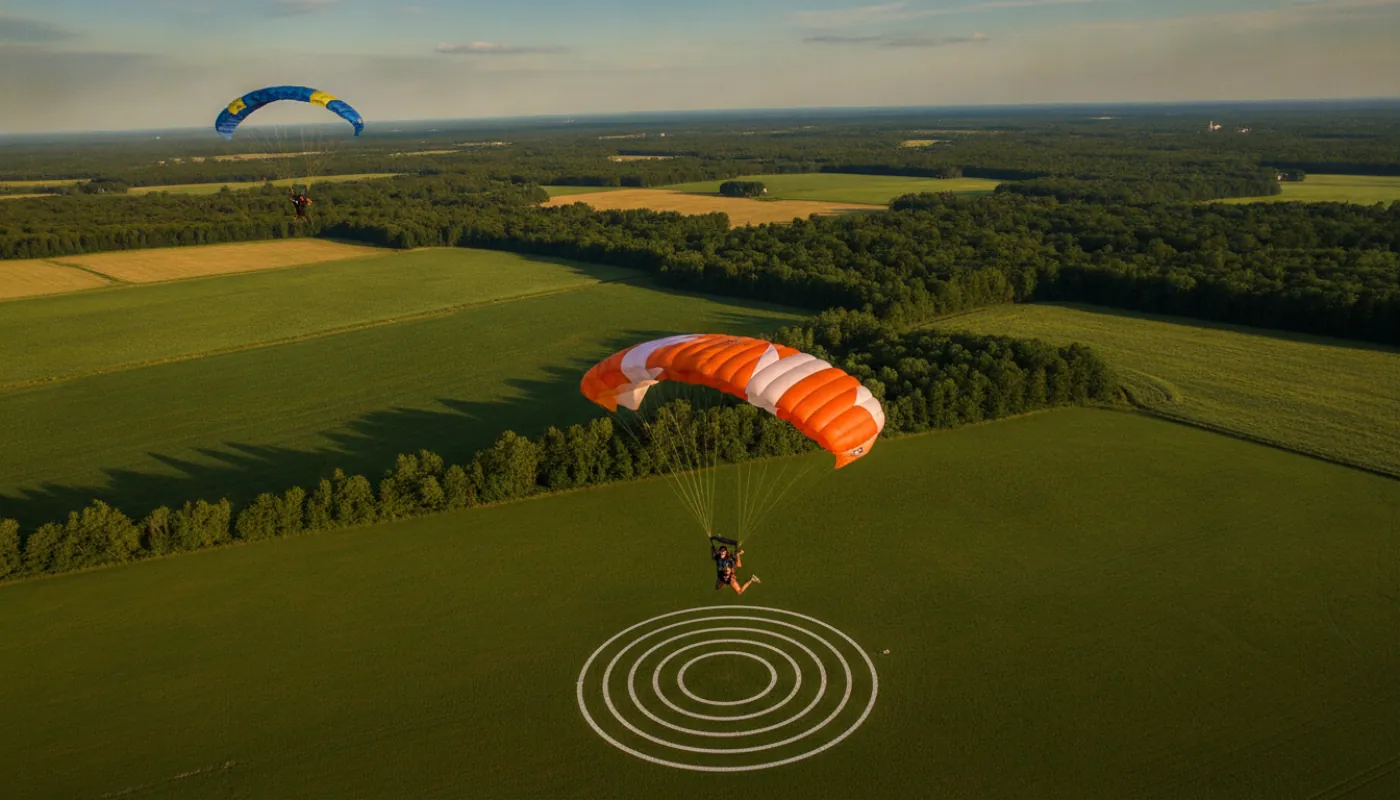
| Accuracy | Landed within 7 feet (2 meters) of target center on 25 jumps |
| Formation | 50 formation skydives or 50 formation freefly skydives, at least 10 with 4 or more participants |
| Written exam | Pass the C-License Exam (75%) |
Look at the accuracy standard: from 33 feet at B to 7 feet at C. That's the real story of this license. It's not a bigger number of jumps so much as a demand for genuine precision, repeated 25 times.
Privileges: all B privileges, plus eligibility for USPA Instructor ratings (except Tandem Instructor), and eligibility to participate in certain demonstration jumps.
D License: The Top
Requirements:
| Item | The standard |
|---|---|
| Prerequisite | Hold or meet all current requirements for a USPA C license |
| Jumps | 500 |
| Freefall time | At least three hours (180 minutes) of accumulated controlled freefall |
| Skills | Complete at least two of five optional skills (a requirement may be repeated) |
| Written exam | Pass the D-License Exam (75%), conducted by a current S&TA, Examiner, Judge Examiner, or board member |
The two-of-five structure is the part people get wrong most often, and it's worth stating plainly: a night jump is NOT required for the D license. It's one option among five. Pick any two of:
- A night jump, following SIM recommendations
- Landed within 7 feet (2 meters) of target center on 100 jumps
- Participated in a canopy formation of a 3-stack or larger, completing a full rotation
- Completed an intentional water jump
- Completed 100 formation skydives, at least 25 of them with 8 or more participants
Privileges: all C privileges, and eligibility for all USPA ratings. A valid D license also satisfies the FAA's "master parachute license" requirement, which is why it's the license behind a tandem instructor rating.
One arithmetic note worth correcting, since it appears in a lot of skydiving writing: 500 jumps is roughly eight hours of freefall, not the "200+ hours" you'll sometimes read. USPA's D minimum is three hours precisely because a jump is about a minute of freefall, not twenty.
The Freefall-Time Ladder
The clearest way to see the system is the accumulation requirement, which is the one thing you can't shortcut with a good weekend:
| License | Jumps | Accumulated freefall |
|---|---|---|
| A | 25 | (none required) |
| B | 50 | 30 minutes |
| C | 200 | 60 minutes |
| D | 500 | 3 hours |
Droguefall time counts toward the total, which is why tandem instructors accumulate it quickly.
Cost and Timeline
Expect the AFF instructional course itself to run roughly $1,500–3,000, and a complete A-license package (course plus coach jumps plus solos to 25) to run about $3,200–4,700 at major US drop zones. Rental gear afterward runs roughly $20–40 per jump.
Beyond that, the jump numbers set the pace, and they're minimums rather than targets. Some jumpers reach C in 18 months; others take three years. Weather, money, and how far you live from a DZ matter more than talent. The jumpers who blitz the numbers often plateau, because a license earned by checking boxes leaves you holding a card and not much else.
One more thing worth knowing: USPA issues Restricted licenses for applicants with disabilities who can't meet a specific requirement, by board-approved waiver. The system has a door for people it wasn't originally designed around.
What the Ladder Is Actually For
Each license is a filter, and each one changes what you're allowed to do rather than just what you're called.
A gets you into the sky alone. B makes you fly your canopy on purpose. C makes you precise and opens instruction. D opens everything.
Nobody's going to check your license at the bar. But the requirements exist because the sport learned each of them expensively, and the jumpers who take the accuracy standards and the canopy card seriously, rather than grinding jump numbers, are the ones still jumping in twenty years.