The question comes up at nearly every drop zone: "When can I start flying a wingsuit?"
The answer has a hard number in it, and it's worth being precise, because a lot of what's written about this online is wrong in ways that matter.
The Actual Requirement
USPA's Basic Safety Requirements state it plainly: any person performing a wingsuit jump must have at least 200 skydives and hold a current skydiving license.
Three things follow from that sentence that commonly get garbled:
- It's a requirement, not a recommendation. The 200-jump minimum is a BSR. It's waiverable only by a USPA Examiner, not by you, your buddy, or a DZ that likes you.
- It's a current license, any current license. Not specifically a B. If you hold an A and you've got 200 jumps, you meet the BSR. (Many DZs and coaches will still want to see more experience than the floor; that's their prerogative, and it's usually good judgment.)
- There is no recency window and no shortcut. You'll see "200 jumps within the preceding 18 months" repeated across the internet. That phrase does not appear in the SIM. Don't plan around it, and don't let anyone tell you a lower jump count is fine if they're recent.
Separately, USPA recommends you take a first flight course (FFC) with an experienced wingsuit coach before your first wingsuit jump. Nobody serious skips it, and a good coach will hold a current USPA Coach rating and be a highly experienced wingsuit pilot. The drop zone decides who's allowed to run an FFC on their turf.
What a Wingsuit Actually Does
Before the numbers, fix the mental picture, because the "120 mph in a flying suit" line you've read everywhere is exactly backwards.
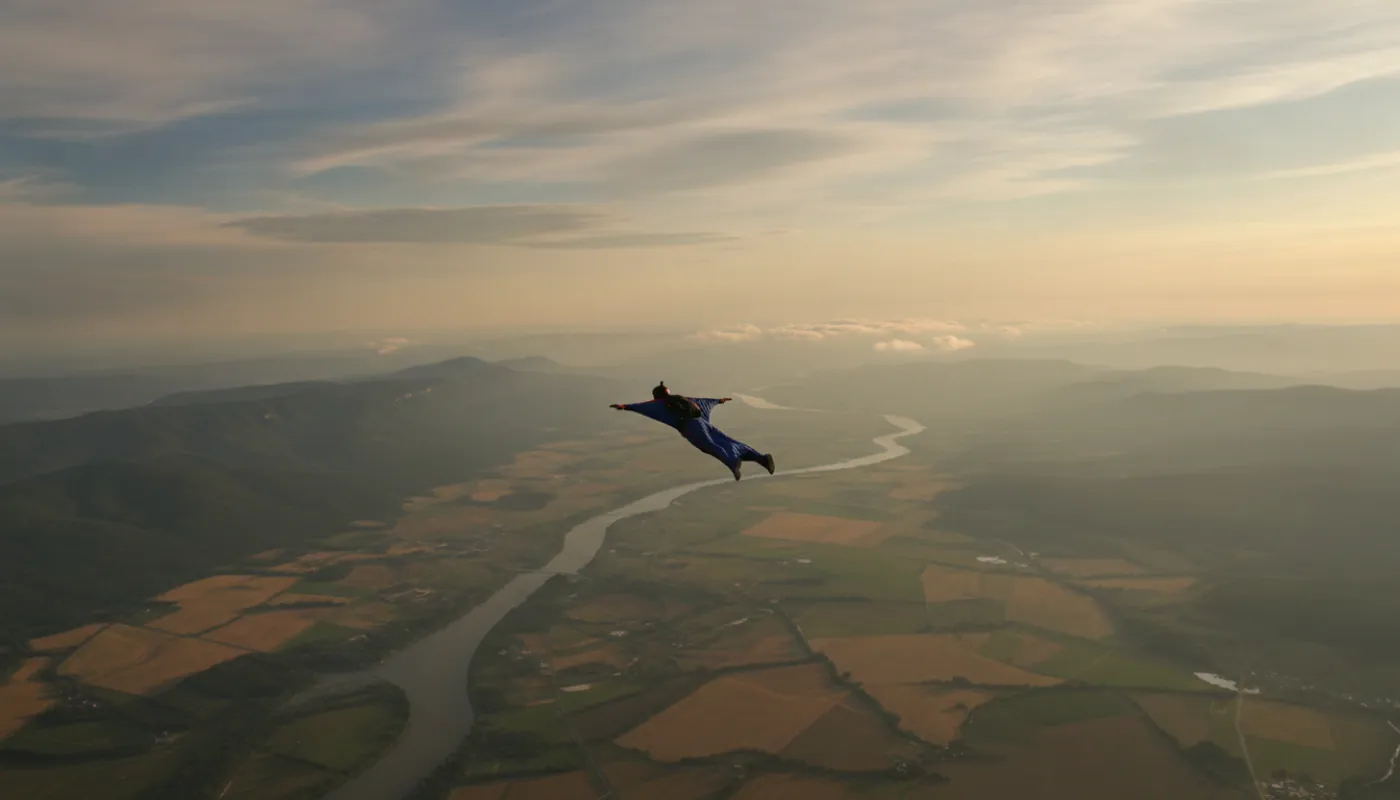
120 mph is belly-flat terminal velocity. It is the speed a wingsuit takes away. The suit is a wing: it decreases your vertical speed and increases your horizontal speed. A wingsuit pilot typically falls at something like 40–60 mph while moving forward at roughly 100 mph, at a glide ratio in the neighborhood of 3:1.
That trade is the whole discipline, and it's also the source of every hazard that follows. You are now a slow-falling, fast-moving object sharing airspace with fast-falling, slow-moving ones, and you're wearing a suit that has zipped your arms to your body.
What 200 Jumps Is Really Buying
The number isn't a hazing ritual. It's a proxy for a set of things you can't fake.
By 200 jumps you've had off-heading openings and fixed them. You've had a hard opening. You've flown in company and learned where other people are without being told. You've been talked down from a bad spot, landed out, and landed downwind. You've made enough small mistakes to know what your mistakes look like, and that self-knowledge, not the jump count, is the real prerequisite.
The honest test isn't "do I have 200?" It's: can I describe my last five errors, and what I changed? If that question comes back blank, the number isn't going to save you.
Canopy and Gear: the Rules Most Articles Omit
This is the section that gets left out of wingsuit explainers, and it's the one with the specifics that keep you alive. USPA's wingsuit guidance is unusually concrete.
Your canopy matters more than your suit. Wingsuit deployments happen in a body position that punishes twitchy wings:
- Fly a non-elliptical canopy with reliable, on-heading openings.
- Beginner wingsuit pilots should load no more than 1.3:1. Experienced wingsuit pilots, no more than 1.5:1.
Note what that rules out: this is not the moment to be on the smallest, snappiest canopy you can hold. Advice telling you to go fly "a smaller, faster canopy" before wingsuiting has it precisely inverted.
Your deployment system matters too.
| Item | The rule |
|---|---|
| Pilot chute | At least 26 inches in diameter |
| Bridle | At least 7 feet from pin to pilot chute |
| Deployment system | Bottom-of-container throw-out only, it's the only system wingsuit pilots should use |
| AAD | Required, plus an RSL with a MARD |
| Altimeter | Visual altimeter mounted on the chest strap or mud flap, you can't read a wrist mount with your arm wing inflated |
| Camera | Not until your exits, flights, and deployments are routine |
Emergency Procedures Are Genuinely Different
Here's the part that separates wingsuit flying from every other discipline you've done: the suit can stop you reaching your own handles.
Arm wings can obstruct a normal deployment and can prevent you from grabbing your risers until they're unzipped. That changes the malfunction logic in ways you must have automatic before you exit:
- High-speed malfunction: execute emergency procedures immediately, do not stop to unzip.
- Low-speed malfunction: you may need to unzip the arm wings first to reach what you need.
- Decision altitude moves up. A wingsuit increases the time required to perform emergency procedures, so plan on deciding by 2,500 feet or higher.
Line twists deserve their own warning: rubber-band deployment bags can release the lines asymmetrically, which is a leading way wingsuit openings go sideways.
And after a good opening there's an order to things: clear your airspace, unzip the arm wings, do your housekeeping, stow the tail wing. In that order, every time.
The single most dangerous moment of a wingsuit jump is the exit. Head into the relative wind, do not jump up, and do not open your wings until you are below the tail of the aircraft. Ask the pilot for an engine cut. A tail strike ends the conversation.
Where You Fit on the Load
A wingsuit changes your relationship with everyone else in the plane, and the rules exist because of it.
You exit last. Wingsuiters follow the aircraft along the jump run after exit, so they go out at the end.
You fly a planned flight path, decided before you board. The standard technique is to fly perpendicular to the jump run to build lateral separation, then turn downwind. You do not freelance this at 13,000 feet.
Loads get managed around you. It's often safest to limit a load to no more than two movement groups and one wingsuit group.
You open high, in shared airspace. Beginner wingsuit pilots deploy at a minimum of 5,000 feet AGL, with breakoff higher than you're used to: around 6,500 feet, arriving at the planned deployment spot by about 5,500. That puts you under canopy in the same slice of sky as tandems and students. Fly like it.
The First Flight Course
The FFC is a ground day plus coached jumps, and the ground work is not a formality.
You'll spend real time on a creeper, working body configurations, pitch and angle of attack, heading control, and practice touches, and then at an aircraft mockup, drilling spotting, climb-out, check-in, and exit until they're boring. (Ignore anyone promising "simulator practice." There is no wingsuit simulator. There's a creeper, a mockup, and a coach.)
Then you fly it with your instructor, for several jumps, before you go solo in the suit. The goal of the FFC isn't to make you good. It's to make sure nothing on your first flight is a surprise.
After the First Flight
Your first wingsuit jump isn't the finish line, it's day one of a new discipline, and you are a student again.
Two published progression rules are worth more than any jump-count folklore:
Learn new skills small. Regardless of your wingsuit experience, learn new wingsuit skills in groups no larger than a 3-way.
Size up the suit slowly, on the manufacturer's schedule. Wingsuit size progression should follow the manufacturer's guidance on minimum jump numbers. Bigger suits are more wing, more performance, and a great deal less forgiveness, and every manufacturer publishes the jump numbers they want to see before you get into one.
The rest is repetition. Motor learning in a wingsuit is fast but perishable, and the jumpers who progress are the ones who fly the suit regularly rather than once a season. Find a DZ with an actual wingsuit community, a coach who'll keep flying with you, and a culture that values progression over ego. That, far more than your 200th jump, is what determines whether you become a wingsuit pilot or just someone who owns a wingsuit.