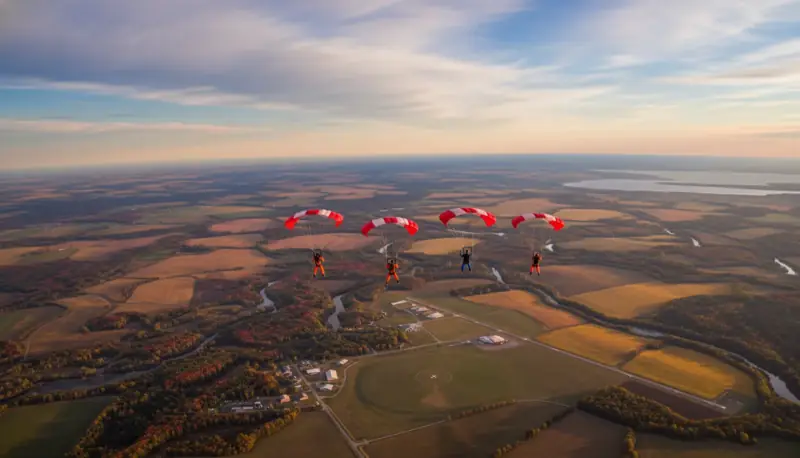
Your first skydive comes in two shapes. You can jump attached to an instructor (tandem), or you can start the training course that leads to your own license (AFF, Accelerated Freefall). Both put you out of a plane. What differs is everything that happens afterward.
One thing to settle up front, because most guides present this as a clean either/or and it frequently isn't: many drop zones require you to do a tandem or two before they'll take you into AFF. Skydive Spaceland and Skydive Chicago both want two tandems; Skydive Arizona wants at least one within the past year. So for a lot of readers the real question isn't "which one", it's "am I doing a tandem and stopping, or a tandem and continuing?"
The Gates Nobody Mentions Until You Call
Before budgets and philosophy, three hard filters. These knock out more people than cost does.
| Gate | The reality |
|---|---|
| Age | 18 minimum, US-wide, per USPA's Basic Safety Requirements. No exceptions, no parental-consent workaround |
| Weight | Tandem limits are real and vary by DZ: Skydive Arizona 220 lb (men) / 200 lb (women); DeLand 220 lb; Spaceland and Perris 240 lb (Perris adds a $25 fee over 220); Skydive Chicago 250 lb |
| Health | You'll need an FAA third-class medical, a physician's fitness certificate, or a signed USPA medical statement. Some DZs require a doctor's recommendation for older jumpers, Skydive Arizona does at 75+ |
And one line item that never shows up in the marketing: if you're training toward a license, USPA membership is mandatory, roughly $98/year, plus about $43 for the A-license application itself. Some DZs bundle it; several itemize it.
What a Tandem Actually Is
You're harnessed to an instructor who has done this thousands of times. You exit together, fall together, land together. Your job is to arch, keep your head back, and let it happen.
The honest timeline, since this is the thing most articles get wrong:
| Phase | How long |
|---|---|
| On the ground: paperwork, briefing, gear fitting, waiting | 2–3 hours |
| Climb to altitude | 15–20 minutes |
| Freefall | About 60 seconds (roughly 45–70, depending on exit altitude) |
| Under canopy | 5–7 minutes |
That freefall number is worth burning in, because a great deal of published skydiving content claims a tandem gives you five minutes of freefall. It does not, and no skydive ever has. Sixty seconds is the real, extraordinary thing you're buying.
Tandem asks nothing of you but nerve. You don't need to be fit, you don't need to study, and you don't need to want to do it again. It's the lowest-commitment way to find out whether the sport is for you, which is exactly what it's for.
What AFF Actually Is
AFF is a structured course of about seven to eight instructor-supervised jumps, not, as it's often described, a progression through the A, B, C and D licenses. Those licenses come later, over years, and have nothing to do with AFF.
The shape of it:
- Ground school, one day, roughly four to eight hours. Most students jump the same day.
- AFF Levels 1–3, two instructors hold onto you on exit and in freefall.
- AFF Levels 4 onward, one instructor. (This is why the early jumps cost more; you're paying for two people.)
- After AFF, coach jumps and supervised solos, building toward the 25-jump minimum for a USPA A license.
That last step is where most of your jumps actually live. AFF is the first eight; the A license is the next seventeen.

What It Really Costs
Here's where most comparisons mislead badly, by quoting a per-jump price and multiplying it by 25. That's not how anyone buys it. Every major drop zone sells a complete A-license package, and the real numbers are lower than the internet's folklore.
Tandem, 2026 base prices (before video):
| Drop zone | Base tandem |
|---|---|
| Skydive Elsinore | $199 |
| Skydive Perris | from $199 |
| Skydive Spaceland Houston | $229–279 |
| Skydive DeLand | $237 |
| Skydive Arizona | $259 |
| Skydive Chicago | $289 ($319 walk-in) |
Video and photo packages add roughly $65–229 on top. If you've seen "$300–500" quoted for a tandem, that's a base jump plus media, presented as the base jump.
A-license packages, 2026:
| Drop zone | Package price |
|---|---|
| Skydive Spaceland Houston ("A License in a Week") | $3,226, 25 jumps, includes USPA membership and the license fee |
| Skydive Chicago | $3,620 |
| Skydive Elsinore | $4,099 prepaid ($4,292 itemized) |
| Skydive Arizona (ASP Economy) | $4,199, 24 jumps |
| Skydive Perris (PSP) | $4,450 prepaid ($4,701) |
So: roughly $3,200–$4,700 to a license, not $4,000–6,000. The reason the folklore number is high is that people assume every jump costs $200–300. Only the instructor-supervised AFF levels do. After that, coach jumps run about $169–210 and solo jumps as little as $39–86. The tail of your training is cheap.
Two costs to check before you commit: some programs require wind tunnel time that isn't in the package price (Perris: two sessions at $235 each; Skydive Arizona: $190), and a first-jump-course-plus-jump on its own runs about $260–409 depending on the DZ.
And you do not need to buy gear. This is the most common budgeting myth in the sport. Student jumps include equipment, and licensed jumpers rent: DeLand charges $37/jump or $74/day, Spaceland $30/jump, Perris $125/day. Most jumpers buy their first rig somewhere around jump 100–200, once they know what they want. A used complete rig runs roughly $2,500–5,000 (new is $8,000–14,000), and there is no rush to get there.
The Timeline
Tandem is one day. Show up, jump, go home changed.
AFF is a season. Expect three to six months of regular visits, gated by weather, DZ scheduling, and repeated levels, which are normal, not failure. Several DZs now sell accelerated formats: Spaceland and Skydive Chicago both market an "A License in a Week," which is exactly what it sounds like if you can take the time off.
Which Path Fits
Do you think you'll want to jump again? That's the whole question. If you genuinely don't know, do the tandem. There's no financial regret and no guilt in stopping.
Can you give it the time? AFF is a commitment of weekends over months. If your calendar can't hold that, tandem is the honest choice, not the lesser one.
Can you carry the cost? Tandem is a couple hundred dollars. A license is three to five thousand, plus membership, plus the jumps after. If that's not there right now, it'll still be there next year.
What kind of challenge do you want? Tandem is about courage, you're strapped to an expert and the day is about the sensation. AFF is about skill. You'll study, be graded, and occasionally repeat a level.
Do you want the community? This is the underrated one. Tandem students are guests at the drop zone. AFF students become part of it within a month: the same faces every weekend, the same packing mat, the same people who'll teach you things for free for years.
Getting Started
Both are legitimate first jumps, and the people who choose AFF aren't braver, they just answered those questions differently.
Call your drop zone and tell them the truth: your budget, your schedule, whether you think you'll be back. They've walked hundreds of people through this exact decision and they'll tell you honestly which one fits. Ask whether they require tandems before AFF, what their tandem weight limit is, and whether tunnel time and USPA membership are inside or outside the package price.
Then show up, listen to the brief, get in the plane, and go.
Ready to find a drop zone? Browse our drop zone directory, every listed DZ shows the programs it runs, from tandems to full AFF progression.