Accelerated Freefall is the fastest route from "never jumped" to "jumping alone." It is also frequently misdescribed, including by articles that should know better, so start with the two facts that reframe everything else.
AFF is about seven to eight jumps. Not 25. When you finish Level 8, you'll have roughly eight to ten jumps in your logbook.
AFF does not, by itself, get you a license. After AFF come coach jumps and supervised solos, another fifteen-odd jumps, before you reach the 25-jump minimum for a USPA A license. AFF teaches you to survive the sky. The jumps after AFF are where you learn to use it.
A note on names: USPA's current framework is the Integrated Student Program (ISP), which organizes training into Categories A through H. Most drop zones still say "Levels 1–8," the legacy AFF terminology, and the skills map closely. You'll hear both, and this guide uses the level names you'll actually hear at the DZ.
Who's Holding You, and When They Let Go
This is the part to understand before anything else, because it's the spine of the whole program, and it's the thing most published explainers get wrong.
| Level | Instructors in freefall with you | What's holding you |
|---|---|---|
| 1–2 | Two | Both instructors have hand grips on your harness and the "grippers" on your jumpsuit |
| 3 | Two, but they release you | First freefall with nobody holding on |
| 4–7 | One | Grips only if needed; increasingly hands-off |
| 8 | None | Solo hop-and-pop |
Instructors hold you with hands. They are not attached to you. You'll read that AFF instructors are connected "via bridle systems", that's nonsense; a bridle is the line connecting a pilot chute to a deployment bag, and it has nothing to do with people. Two humans grip your harness and your sleeves, and on Level 3 they let go.
Through Levels 1–5 (ISP Categories A–E) the person with you is a rated AFF Instructor, and they are a genuine safety net: able to stabilize you and, if it came to it, deploy for you. From Category F onward you fly with a USPA Coach, who is a teacher rather than a safety net. That handoff is a real change in who's responsible for your life, and it happens after AFF, not during it.
Levels 1–2: Two Instructors, Hands On
Level 1 is your introduction to freefall with two instructors gripping you from exit to deployment. Your job: hold a stable arch, maintain altitude awareness, respond to hand signals, and perform three practice ripcord pulls.
Those practice pulls start on the very first jump, and they are exactly what they sound like: you reach back and touch your deployment handle, without pulling it. Nothing comes out. Some articles describe a pilot chute popping out to "simulate" the pull, that would be a deployment. The point is muscle memory: your hand finds the handle, under stress, at altitude, three times, before you ever need it.
Level 2 is the same structure (still two instructors, still holding on), with a cleaner exit and better body-position control expected. What you're really building here is the ability to be aware and deliberate while your nervous system is screaming. That takes two jumps at minimum, and there is no shame in taking three.
Level 3: They Let Go
The big one. Both instructors release their grips, and for the first time you're in freefall with nobody holding on.
That's the entire test: stay stable, on heading, altitude-aware, and pull on time, by yourself. Instructors stay close and can re-dock if you need them, but the arch keeping you belly-down is now yours alone. Plenty of students repeat Level 3, and it's the most understandable repeat in the syllabus.
Levels 4–5: One Instructor, Real Tasks
From Level 4 you're down to a single instructor, and you start doing things rather than just existing stably.
Level 4 introduces controlled 90-degree turns. You'll discover that a turn in freefall is initiated with a subtle shift, not a heave, and that overcorrecting is how you end up spinning.
Level 5 steps up to 360-degree turns in both directions: stopping on heading, deliberately, twice. This is where most students first feel like they're flying instead of falling.
Level 6: Solo Exit, Front Loop, Tracking
Level 6 is the first jump you exit the aircraft unassisted, no instructor holding you on the step or in the door.
The dive adds a front loop (an intentional tumble you then recover from: proving you can restore stability after getting flipped) and tracking, the flat, fast, arms-swept body position that moves you horizontally across the sky. Tracking is a survival skill: it's how you get separation from other jumpers before deployment.
Worth clearing up a common confusion: a delta or tracking position speeds you up. Sweeping your arms back and going head-low increases both fall rate and forward drive. It is not a braking position.
Level 7: The Full Dive
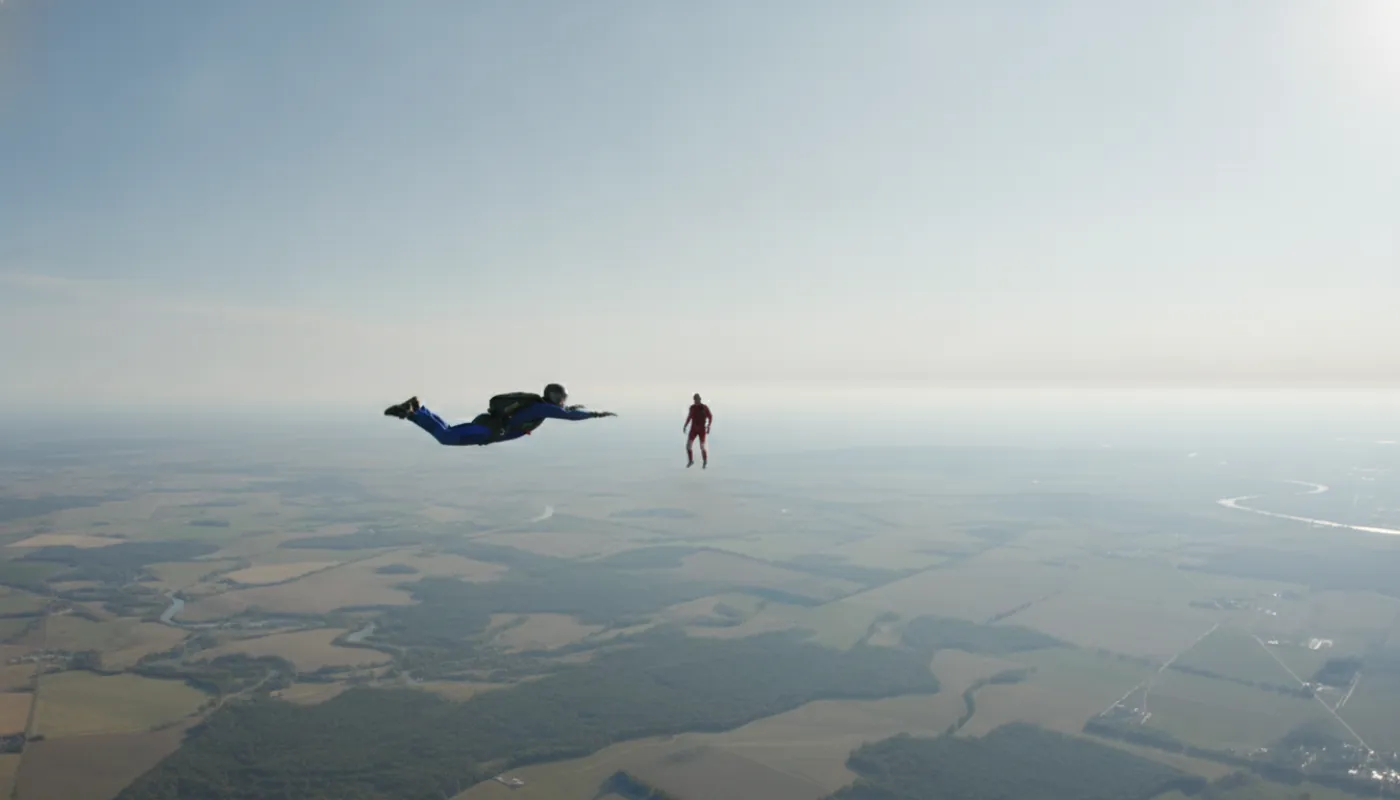
Level 7 puts it together: a solo exit, a front loop, 360s in both directions, and a track away: flown as a complete sequence, with your instructor in freefall alongside you, observing rather than assisting.
This is the comprehensive skills dive. Fly it clean and you've demonstrated everything AFF set out to teach.
Level 8: The Hop and Pop
The last one surprises people, because it isn't a freefall dive at all.
Level 8 is a hop and pop: a low-altitude exit (typically around 5,000 feet), where you get stable and deploy after a very short delay. There is no dive flow and no maneuvers.
Why end on this? Because it's the aircraft-emergency skill. If the plane has a problem at 5,000 feet, everybody gets out and opens, immediately, and a student who has never done it is a student in trouble. It's arguably the most safety-relevant jump in the syllabus, and it's the one most guides omit entirely, some replacing it with an invented "comprehensive final exam jump," which is Level 7's job.
After Level 8: The Part Nobody Tells You About
Finishing AFF does not qualify you for an A license. Here's what still stands between you and that card:
- Coach jumps and supervised solos: ISP Categories F through H, roughly 15–17 more jumps, building freefall skills, docking, tracking, and canopy work
- 25 jumps total, the USPA minimum
- The written exam, 40 questions, 75% to pass
- The oral exam, at least 20 questions, and you need 100%
- The practical exam, the A-license check dive, flown with a USPA Instructor
- Packing your own main, unassisted
- A completed A-License Progression Card, the sign-off document for the whole thing
That's the real bridge, and it's where a lot of new jumpers quietly drift out of the sport, because the structure that carried them through AFF is gone and nobody has told them what to do next.
What the A License Actually Gives You
Once you have it, you may jump without supervision. That's the headline privilege, and it's worth stating because you'll read the opposite, that A-license holders are "still subject to supervision." They aren't. You can also pack your own main, do formation skydives with other licensed jumpers, and train for water landings.
Beyond A, the ladder gets gentler in kind: the B license at 50 jumps adds 30 minutes of accumulated freefall, ten accuracy landings within 33 feet, ten formation jumps, live water training, a canopy proficiency card, and a written exam. Nobody is trying to keep you alive anymore, they're trying to make you good.
AFF is eight jumps and a steep, expensive, exhilarating climb. The license is the next seventeen. The sport is the rest of your life.