Every skydiver relies on a reserve parachute, and very few new jumpers understand who touches it, what the law actually says, or how they'd know if any of it had been done. The question lurking behind most first-timers' nerves is simple: Is anyone really certified to work on my gear, or is this just theater?
It's not theater. Reserve packing is one of the most tightly regulated tasks in civil aviation, and, better than that, the regulation leaves two physical artifacts on your rig that you can check yourself in about thirty seconds. Most jumpers never learn what they are. By the end of this piece you will.
Why the Reserve Is Different
Your main and your reserve are separate systems, and the difference in how they're treated comes down to one word: passivity.
Your main gets used. You deploy it, you watch it open, you land it, and it gets packed again, often the same day. That constant cycle of handling and inspection surfaces problems quickly. A worn line, a small tear, a sticky slider: someone sees it.
Your reserve sits sealed in your container and may not be opened for six months. It has no duty cycle to reveal its own defects. The pack job is the quality control: every fold, every line stow, every bridle routing has to be right the first time, because the next time anyone finds out is the day you need it. That asymmetry is the entire reason for the certification regime.
What an FAA Rigger Certificate Actually Is
A parachute rigger certificate is a federal airman certificate issued by the FAA, not a drop-zone credential. There are two levels, and they are not interchangeable.
| Senior rigger | Master rigger | |
|---|---|---|
| May do | Pack and maintain parachutes they're rated for (14 CFR 65.125(a)) | Pack, maintain, and alter parachutes they're rated for, including major repairs (65.125(b)) |
| May NOT do | Major repairs | – |
| Experience | Pack 20 parachutes of each type sought, under the supervision of a rigger rated for that type (65.115) | Higher experience requirements (65.119) |
| Tests | FAA written, oral, and practical | FAA written, oral, and practical |
The piece almost everyone misses: rigger certificates carry type ratings: Seat, Back, Chest, and Lap (65.121). A sport skydiving rig is a Back. Under 65.129(a), a rigger may not pack, maintain, or alter a parachute unless rated for that type. A rigger certificate by itself is not authority to touch your rig; the right type rating is.
Currency is also real, and it isn't what people assume. There's no continuing-education requirement. Under 65.129(f), a rigger must understand the current manufacturer's instructions and must have performed duties under the certificate at least 90 days within the preceding 12 months.
Who May Pack What
This is the part most articles get wrong, usually by inventing a category of "trained DZ packer" that doesn't exist in the regulation.
| Who may pack it | Interval | |
|---|---|---|
| Main | A certificated rigger, the person who will make the next jump with it, a non-certificated person under a rigger's direct supervision, or the tandem parachutist in command (105.43(a), 65.111(b)) | Packed within the preceding 180 days |
| Reserve | A certificated rigger only (105.43(b), 65.111(a)) | Repacked by a rigger within the preceding 180 days |
Two corrections worth internalizing. First, the main has a 180-day limit too. People say "only the reserve has an interval", not so. The difference isn't whether there's a clock, it's who's allowed to reset it: you reset your main's clock yourself, every time you pack it.
Second, the DZ packer folding mains on the mat at speed is legal because a rigger is directly supervising them, not because they took a class. Training alone isn't the qualifying condition; supervision is. And that's a main. Reserve packing happens in a loft, by a rigger, and you will essentially never watch it.
(A rigger, incidentally, can pack their own reserve. The rule is "packed by a certificated rigger", not "packed by someone else.")
The 180-Day Cycle
Under 14 CFR 105.43(b), the reserve in an approved dual-parachute system must have been packed by a certificated rigger within the preceding 180 days. If it hasn't, the rig is not legal to jump. Full stop.
There's a legacy clause still in the books: a reserve containing any amount of silk, pongee, or other natural fiber must be repacked within 60 days. In practice you'll never meet one, modern sport reserves are synthetic, but that's why you'll occasionally hear an old-timer talk about a shorter cycle.
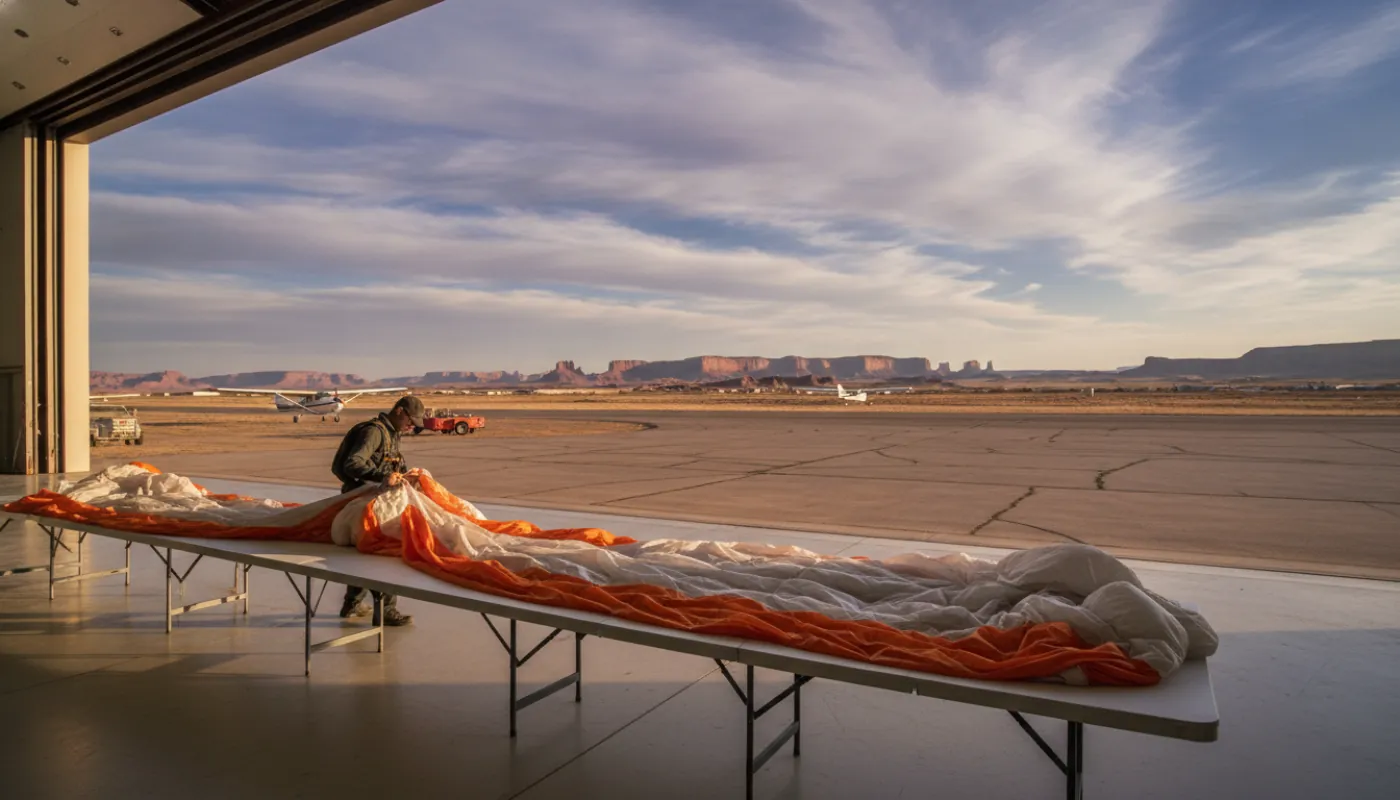
The clock exists because fabric and lines degrade with humidity, heat, and UV exposure whether or not anyone jumps them. The repack is really an inspection with a pack job attached: the rigger opens the system, examines the canopy, lines, bridle, deployment bag, and closing loop, and finds the problems that a sealed container hides. If they find damage, a master rigger may perform a major repair, damage does not automatically mean a trip back to the manufacturer.
The Two Things You Can Actually Check
Here's the practical payoff, and the reason this article exists.
1. The packing data card. Under 65.131(c), the rigger who packs your reserve must record, on the packing record attached to the parachute, the date and place of the pack and a notation of any defects found on inspection, signed with their name and certificate number. The card lives on the rig, usually in a pocket under the reserve flap. It is the "who touched my gear, when, and what did they find" document, and it is legally required to be there.
2. The rigger's seal. Under 65.133, no rigger may pack a parachute unless they hold a seal with an identifying mark assigned to them, plus a seal press, and after packing, they must seal the pack. That little seal on your reserve closing pin is tamper evidence: it says a specific certificated human closed this container and hasn't had it open since.
Card current, seal intact. That's the check. If you're renting gear or looking at a used rig, it's the first thing to look at, and any legitimate DZ or seller will hand it over without a flicker of annoyance.
Separately, the rigger keeps their own records (65.131(a)–(b)) (make and type, serial number, owner, the kind and extent of work, date and place), for at least two years. Those are the loft's files, not something a customer gets handed.
What the AAD Actually Does
An Automatic Activation Device is widely misdescribed, including in a lot of published skydiving content, so be precise about it:
An AAD does not know or care whether your main deployed. It fires the reserve when it senses that you are below a preset altitude and still falling faster than a preset speed. An Expert CYPRES 2, for example, fires at roughly 750 feet AGL if you're descending faster than about 78 mph; the tandem version fires much higher, around 1,900 feet.
The consequences of that logic are worth understanding. It will fire under a high-speed malfunction even though a main is out. And it will not fire if you're below its speed threshold (under a fully open canopy, for instance), no matter how low you are.
Who's required to have one? For tandem, it's federal: 14 CFR 105.45 requires an operational AAD for the reserve, armed on every tandem jump. For students, USPA's Basic Safety Requirements require one. For a licensed solo sport jumper, federal law says only that if an AAD is installed it must be maintained per the manufacturer's instructions (105.43(c)), but AADs are effectively universal in the sport, and many drop zones require one to jump. It is not the line item to economize on.
At the Drop Zone
If you're doing a tandem, all of this has already happened. The dual rig's reserve was packed by a rigger, its card is current, and your instructor checks it as part of their pre-jump gear check along with the AAD's status.
Once you're jumping your own gear, that check is yours. Every jumper (student included, from jump one), is trained to cut away a partial malfunction and pull the reserve manually. The reserve handle isn't license-gated; it's the first thing you learn.
You may see a rigger working in a loft on a busy weekend, a queue of rigs waiting their turn. It's unglamorous, meticulous, slightly boring work, and it is the reason the reserve almost always works. Rigger certification isn't a formality. It's a named person, with a federal certificate, a type rating, a seal, and a signature on a card in your rig, who has accepted responsibility for the parachute you hope never to use.