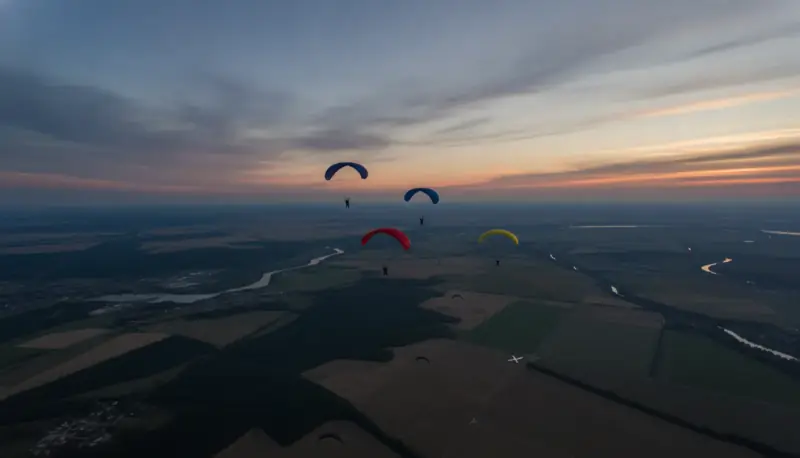
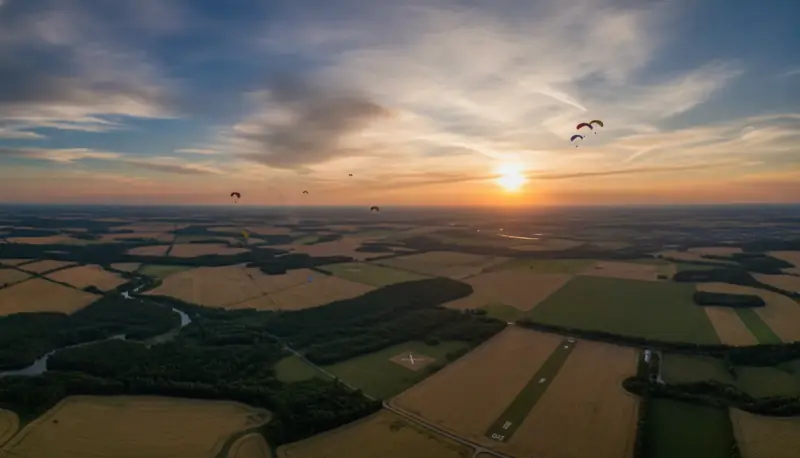
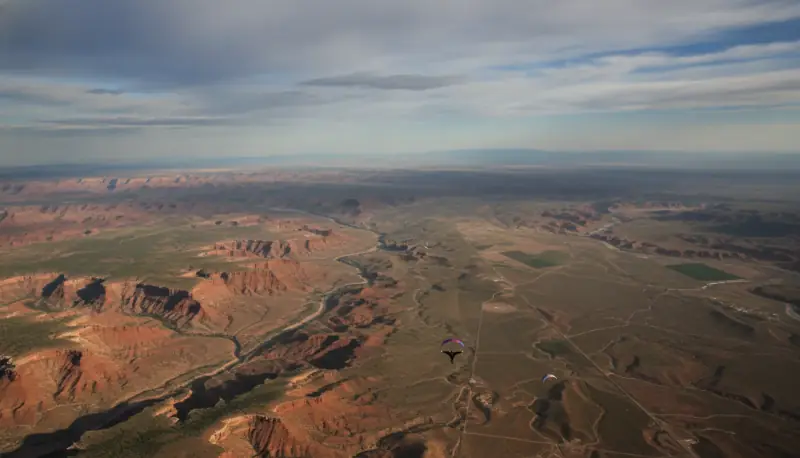
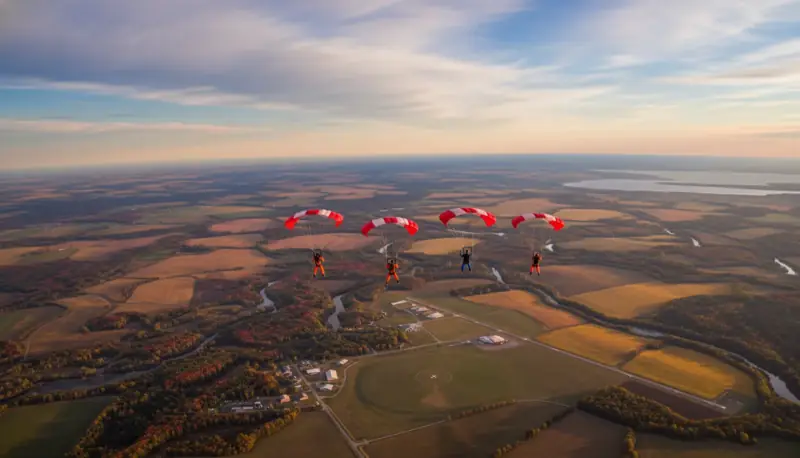
Weather is the single largest reason skydiving operations shut down. If you've booked a tandem or shown up for AFF training only to hear "we're on a weather hold," you've lived it: usually while standing in what looks, to you, like a perfectly nice day.
That's the thing worth understanding: the sky over the landing area is not the sky you're jumping from. Some of what grounds a drop zone is federal law with hard numbers in it, some is the operator's own conservatism, and some is a judgment call about air you can't see from the parking lot. This guide covers all three, so the next time you get scrubbed you'll know exactly what got you.
Cloud Clearance and Visibility: The Federal Numbers
Start here, because these are law, not preference. 14 CFR 105.17 governs parachute operations, and it does two things.
First, the absolute: you may not jump into or through a cloud. Ever. There is no discretion in it, and, contrary to a myth that circulates widely, there is no routine waiver that lets a drop zone jump reduced cloud clearance. (Part 105 waivers exist for things like night jumps and demos into congested areas, not for weather minimums.)
Second, the table. Flight visibility and distance from clouds must be at least:
| Altitude | Flight visibility | Distance from clouds |
|---|---|---|
| 1,200 ft or less above the surface (regardless of MSL) | 3 statute miles | 500 ft below · 1,000 ft above · 2,000 ft horizontal |
| More than 1,200 ft AGL, below 10,000 ft MSL | 3 statute miles | 500 ft below · 1,000 ft above · 2,000 ft horizontal |
| More than 1,200 ft AGL and at or above 10,000 ft MSL | 5 statute miles | 1,000 ft below · 1,000 ft above · 1 statute mile horizontal |
Two things fall out of that table that surprise people.
A standard jump run is governed by the 5-mile row. Tandems typically exit around 13,500 feet, so the tighter visibility minimum, not the 3-mile one everyone quotes, is what actually applies to your jump.
Skydiving is stricter than general VFR flying near the ground. In Class G airspace at or below 1,200 feet, a VFR pilot can legally fly with 1 mile of visibility and merely "clear of clouds." A jumper cannot: 105.17 demands 3 miles and the full 500/1,000/2,000 buffers regardless. If you reason from what a pilot friend tells you, you'll under-apply the rule.
What Part 105 does not contain is a ceiling number. There's no federal "1,000-foot ceiling" rule for skydiving, the constraint is expressed as cloud clearance and visibility, and a low broken layer grounds the operation through those limits rather than a ceiling minimum.
Why any of it exists: those buffers keep jumpers out of cloud entirely, so nobody exits into airspace where they can't see traffic, the aircraft, each other, or the ground they're about to land on.
Wind
Wind is what cancels most days, and it comes in two flavors that don't always agree: surface wind (what you land in) and wind aloft (what you exit and drift in). Calm on the ground with vicious wind at altitude is a very normal, very cancellable day.
For solo students, USPA's Basic Safety Requirements set a hard surface-wind ceiling: 14 mph with ram-air canopies, or 10 mph if the student is on a round reserve. It's waiverable by the DZ's Safety & Training Advisor, but that's the number. Essentially every US student rig is ram-air, so 14 mph is the figure in practice.
For tandems, there is no published USPA or FAA wind limit. The call belongs to the instructor, weighing the student, the canopy, and the day, and most operations set their own conservative house ceiling well below anything sporty. Experienced jumpers on responsive sport canopies work in more wind than either.
Wind aloft matters for a different reason: it determines the spot, where the aircraft has to put you so that you can actually reach the landing area. Strong uppers mean long drifts, tight exit separation math, and the real possibility of an off-DZ landing for anyone who misjudges it.
Then there's wind shear, a sharp change in speed or direction between altitudes. It makes for a rough jump run, unpredictable openings, and turbulence low over the field, which is where it does the most harm. A day can start clean and deteriorate by noon, which is why grounding calls so often come mid-morning rather than at dawn.
Precipitation and Thunderstorms
Rain is a hard stop at most DZs, and not primarily because you'd get wet. Rain travels with low cloud, degraded visibility, and turbulence; it fogs goggles at the exact moment you need to see; and water on canopy fabric changes how the parachute opens and flies in ways nobody wants to discover at 3,000 feet.
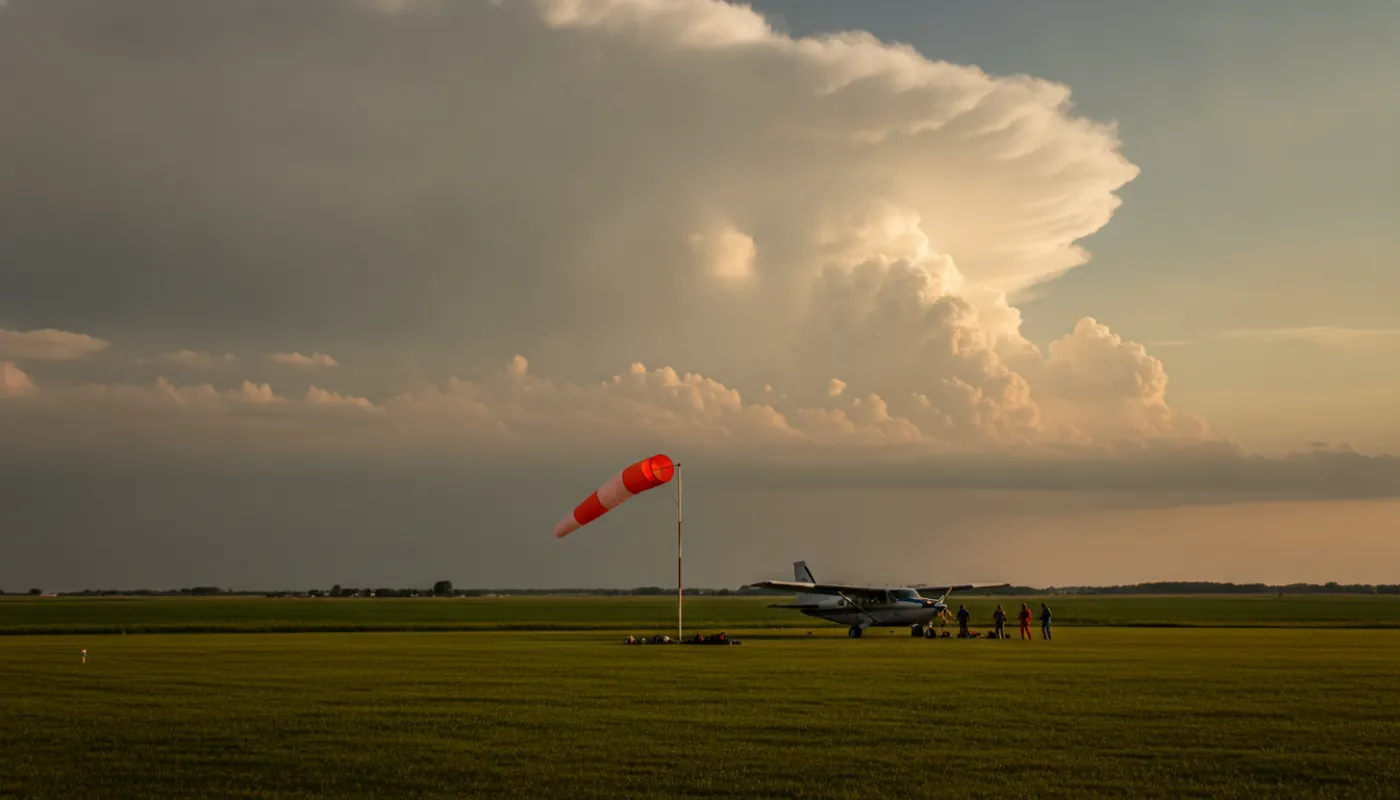
Thunderstorms aren't a judgment call at all. Hail, violent updrafts, and shear inside a convective cell are simply incompatible with putting humans in the air. And the danger radius is far larger than the storm looks: "bolt from the blue" strikes are documented 10 to 15 miles from the parent thunderstorm, with anvil lightning reaching farther still. That's why an operation shuts down for a cell that isn't overhead and may never arrive.
The FAA's own guidance to pilots is to give heavy and extreme radar echoes at least a 20-mile berth. When your DZ scrubs on a bluebird morning because there's convection building 20 miles west, that's the reason.
Density Altitude, And the Thing Everyone Gets Backwards
Hot air is thin air, and thin air changes how your canopy flies. This is where a lot of skydiving writing gets the physics inverted, so be careful here.
High density altitude makes your canopy fly and descend FASTER, not slower. In thinner air, the wing must move faster through it to generate the same lift. The practical consequences, all of them pointing the same direction:
- Higher forward speed and a faster descent rate
- Higher stall speed
- Higher opening forces
- Less flare authority, roughly 4% of your flare effectiveness lost per 1,000 feet of density altitude
So the hot summer afternoon doesn't give you a gentle, floaty landing. It gives you a hot one, arriving faster, with a flare that does less than you expect. That's the day you land long and hard if you fly it on muscle memory from a cool morning.
It also hurts the aircraft, which climbs worse and hauls fewer people per hour, but that's the operator's problem, not yours.
One clarification, because the examples get mangled: density altitude is mostly about heat, not field elevation. Eloy, Arizona (Skydive Arizona) sits around 1,500 feet MSL and Lake Elsinore around 1,265 feet, both essentially low-elevation fields. They are canonical high-density-altitude drop zones anyway, because in July the air behaves like it's thousands of feet higher. Genuinely high-elevation DZs, like those on the Denver front range at roughly 5,000 feet, live with it year-round. All of them run full summer schedules; density altitude is a thing you fly for, not a thing that closes the DZ.
How the Call Actually Gets Made
Drop zone operations watch several streams, and it's worth knowing what each one does and doesn't tell them.
| Source | What it gives you |
|---|---|
| METAR | Current surface observation at a nearby airport: wind, visibility, ceiling, present weather |
| TAF | Forecast surface conditions near that airport, typically 24–30 hours out, within about a 5-mile radius |
| Winds & Temperatures Aloft (FB/FD) forecasts, model soundings, RAOB data | The actual upper-level winds, what you'll drift in |
| The DZ's own uppers | A wind-drift indicator or the first load's observations, ground truth, and often the deciding input |
Note the trap in that table: METAR and TAF do not contain winds aloft. They're surface products. A DZ manager reading only METARs is flying half-blind to the thing that determines the spot, which is why the uppers and the first load matter so much.
The morning sequence is usually the same everywhere. Early, the forecast decides whether to open at all. As METARs update, the picture sharpens. By mid-morning most DZs know whether they're flying, and cancellations come either because conditions are already marginal or because they're forecast to go bad soon. Arriving at noon to a closed DZ that was jumping at 8 a.m. is completely normal, the afternoon forecast beat you there.
And the final call is judgment, not arithmetic. Two experienced managers can look at the same borderline day and decide differently, based on their aircraft, their student load, and their tolerance. Conservative operations cancel more often and jump fewer days; aggressive ones fly more and accept more risk. Neither is reading a different regulation. They're weighing the same one differently.
One Non-Weather Reason You'll Sit
Worth knowing, because it produces the same standing-around: weather isn't the only thing that holds a jump run. Under Part 105, parachute operations need ATC authorization in controlled airspace (Class A, B, C, and D, and over restricted or prohibited areas), and the DZ must notify the controlling ATC facility for Class E and G operations, no earlier than 24 hours and no later than 1 hour before. Aircraft in controlled airspace also need two-way radio contact.
So on a perfect blue day, a busy airspace and a controller who can't clear the jump run right now will park you on the ground just as effectively as a cloud deck.
What to Do About It
Trust the call. The cost of a cancellation is a wasted Saturday. The cost of jumping a day that shouldn't be jumped is measured in a different unit entirely, and the jumpers with thousands of jumps are, without exception, the ones who walk away from marginal days the fastest.
Book with a DZ whose rebooking policy makes standing down free, arrive expecting to wait, and treat a scrub as evidence you picked the right operation.