Skip to content
Top-rated outdoor gear, ranked

Best Of 2026

Best Skydiving Goggles of 2026

Our top 11 picks, independently ranked. Budget to premium.

Skydiving is uniquely hard on your eyes. At terminal velocity you're staring into a 120 mph wind, often after climbing through 13,500 feet of temperature swings that love to fog a lens, and a pair of goggles that floods, fogs, or pops off in the door is worse than useless, it's a safety problem. Unlike ski or moto eyewear, jump goggles also have to play nicely with an open-face helmet, sit flat enough not to break the seal, and survive being crushed in the bottom of a gear bag week after week. That's why the category looks so different from a typical Amazon search: the products that working skydivers actually buy are lightweight, vented, frameless, and cheap enough to replace, not $200 fashion pieces.

This guide is built for that reality: for AFF and tunnel students who just need a reliable, fog-free pair to see their altimeter and their instructor, and for licensed jumpers who want better optics, a wider field of view, or an over-the-glasses fit. The good news is that this is an affordable category: the best goggle in the sport costs less than a single jump ticket, and even the "premium" options rarely break $40. The differences that matter are fit, peripheral vision, venting, and whether the lens flexes to seal against your face.

We focused on goggles that are currently stocked at the major skydiving retailers (ChutingStar, Rock Sky Market, Para Gear, Akando) in 2026, span the realistic price spectrum from bargain student goggles to the nicest optics money can buy in this niche, and have a track record on the dropzone. Every pick below is a genuine, buyable model, no vaporware, no rebadged motorcycle goggles pretending to be jump gear.

At a glance

#ProductPrice
1$25–$32
2$16–$22
3$20–$30
4$34–$42
5$20–$28
6$26–$34
7$14–$20
8$30–$38
9$22–$28
10$20–$28
11$15–$22
13-Five Goggles
Best OverallMid-range

1. 13-Five Goggles

Kroop's

$25–$32

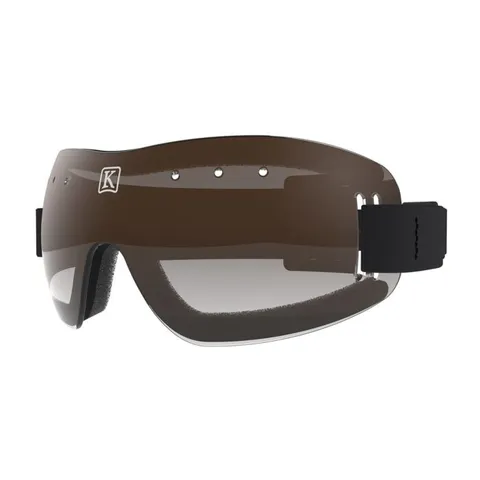
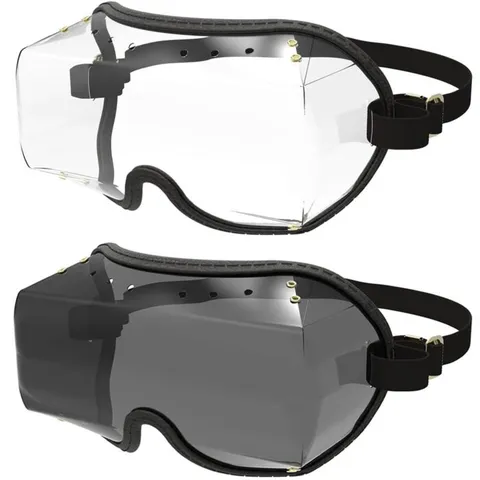
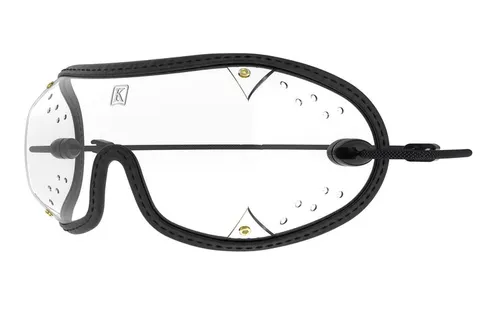
The de facto standard goggle of the sport: a frameless, low-profile design named for the classic 13,500-ft exit altitude that fits flat under nearly any open-face helmet and vents well enough to stay clear.

Best for: Any licensed jumper or student who wants one do-everything goggle that fits under their helmet

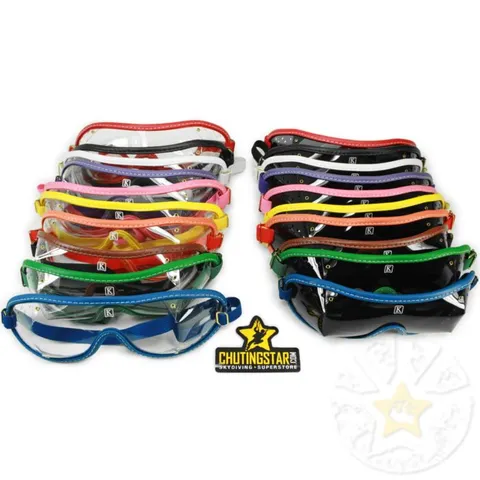
Slim frameless shape is the most helmet-compatible on the market · Anti-fog ventilation holes keep the lens clear under canopy and in freefall · Impact-resistant, flexible lens with UV-A/UV-B protection · Made in the USA and offered in a wide range of lens tints

Minimalist seal lets a little air in on some face shapes · Not an over-the-glasses fit

Boogie Goggles
Best ValueBudget

2. Boogie Goggles

Kroop's

$16–$22

A lighter, more heavily vented evolution of the classic Kroop's goggle that improves peripheral vision while staying one of the cheapest dependable options in the sky.

Best for: Budget-minded jumpers and students who want a no-fuss everyday goggle

Excellent peripheral vision for the price · Extra venting fights fogging on slow climbs · Very lightweight and helmet-friendly · Frequently cited as the best value goggle in skydiving

Thin lens flexes more than premium optics · Open venting isn't ideal for cold or rainy loads

SORZ Skydiving Goggles
Editor's PickMid-range

3. SORZ Skydiving Goggles

SORZ

$20–$30

Renowned for one of the widest fields of vision in skydiving, SORZ wrap a big distortion-free lens around a cushioned seal, a favorite of jumpers who hate the tunnel-vision feel of small goggles.

Best for: Experienced jumpers who prioritize maximum peripheral vision

Class-leading wide, wraparound field of view · Cushioned seal around the full edge improves comfort and reduces leaks · Heavy-duty adjustable strap and anti-fog lens · Available in clear, smoke, yellow and mirrored lens options

Larger footprint can crowd some compact open-face helmets · Lenses aren't user-interchangeable, pick your tint at purchase

Cadence Goggles
Best PremiumPremium

4. Cadence Goggles

Kroop's

$34–$42

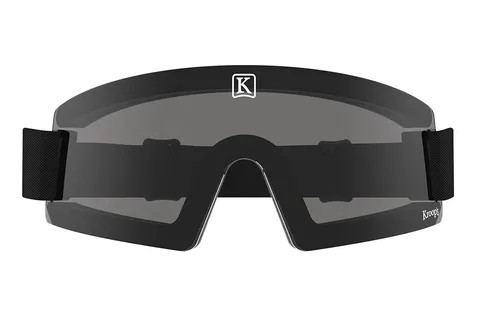
Kroop's most refined modern goggle, with an updated frame and lens geometry aimed at jumpers who want the cleanest optics and a more contoured fit at the top of the category.

Best for: Licensed jumpers who want the nicest optics in jump-specific eyewear

Updated lens shape for sharp, low-distortion optics · More contoured fit and finish than the classic Kroop's line · Still helmet-compatible despite the upgraded design · Made in the USA

Most expensive Kroop's goggle · Premium polish is subtle versus the cheaper 13-Five

VFR Over-The-Glasses Goggle
Mid-range

5. VFR Over-The-Glasses Goggle

Kroop's

$20–$28

The go-to over-the-glasses goggle for skydivers who jump in prescription frames, with a roomier chamber that seals over eyeglasses without crushing them.

Best for: Skydivers who wear prescription glasses under an open-face helmet

Genuinely fits over most prescription eyeglasses · Vented to resist fogging even with the larger air chamber · Affordable solution versus prescription inserts · Made in the USA

Bulkier than standard goggles, so check helmet clearance · Fit over very large frames can still leave gaps

Vision Goggles
Mid-range

6. Vision Goggles

Akando

$26–$34

A comfort-focused medium goggle from Akando with a distortion-free polycarbonate lens, anti-fog/anti-scratch coatings and a soft dual-foam seal, and it ships with a hard case and pouch.

Best for: Jumpers who want a comfortable, well-protected mid-tier goggle that comes with storage

Distortion-free lens with anti-fog and anti-scratch coatings, UV400 · Comfortable dual-foam seal and good peripheral vision · Compatible with most skydiving helmets · Includes a free hard case and soft pouch

Sold from Europe, so US pricing and shipping vary · Single-tint lenses, not swappable

Flexvision Goggles
Best BudgetBudget

7. Flexvision Goggles

Flexvision

$14–$20

The number-one choice for student operations and wind tunnels worldwide: dirt-cheap, durable, and built around a quick-adjust mechanism that survives constant rental abuse.

Best for: AFF students, dropzone rental fleets, and tunnel flyers on a budget

Cheapest reliable goggle here, ideal for students and tunnel time · Quick-adjust strap mechanism for fast fitting between flyers · Durable enough for high-turnover rental use · Lightweight and helmet-compatible

Basic optics and seal compared with mid-tier goggles · Utilitarian looks

Xtra Vision Goggles
Premium

8. Xtra Vision Goggles

Akando

$30–$38

The biggest goggle in Akando's line, built for maximum peripheral vision and roomy enough to double as an over-the-glasses option, with the same distortion-free lens and dual-foam comfort as the Vision.

Best for: Jumpers wanting the widest view or a roomy over-glasses fit

Largest field of view in the Akando range · Big enough chamber to fit over many eyeglasses · Distortion-free lens with anti-fog/anti-scratch and UV400 · Comes with hard case and pouch

Large frame may not fit compact helmets · Imported from Europe; US availability through specialty shops

Peeksteep Skydiving Goggles
Mid-range

9. Peeksteep Skydiving Goggles

Peeksteep

$22–$28

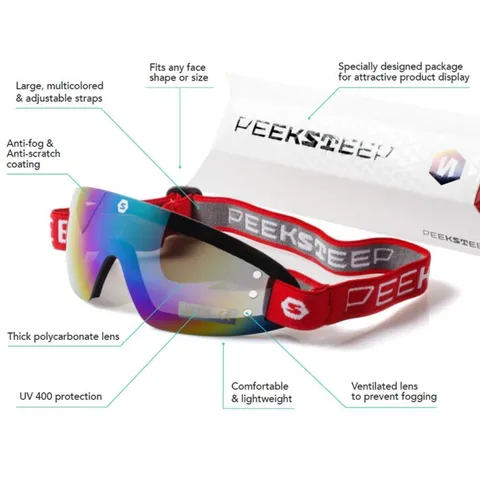
A thick-lensed, color-coordinated goggle popular for matching your rig, with anti-fog/anti-scratch coatings and a wide adjustable strap, clear optics when it seals well to your face.

Best for: Style-conscious jumpers who want to color-match their goggles to their rig

Thick polycarbonate lens with anti-fog and anti-scratch coatings, UV400 · Many strap-and-lens color combos to match your gear · Wide adjustable strap and ventilated lens · Often praised for clarity when reading an altimeter

Stiff lens doesn't flex much, so it can leave gaps on narrow faces · Seal quality is fit-dependent

Flex Z Goggles
Budget

10. Flex Z Goggles

Flex Z

$20–$28

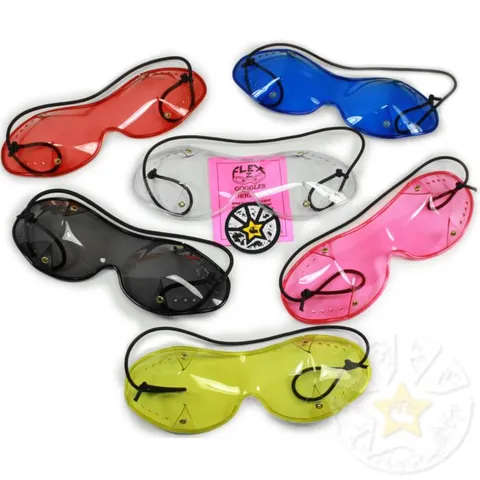
Foldable, near-indestructible goggles made from a memory material that springs back to shape after being stepped on, sat on, or crushed in a gear bag, offered in a large over-the-glasses size.

Best for: Jumpers who keep destroying goggles in their gear bag

Memory material returns to shape after being crushed · Foldable for compact gear-bag storage · Large size fits over many eyeglasses · Hard to permanently damage

Optics and seal are basic versus rigid premium goggles · Flexible frame can feel less secure at high speed

DZ II Goggles
Budget

11. DZ II Goggles

Kroop's

$15–$22

An updated classic with a flexible, scratch-resistant, unbreakable lens and a patent-pending cinch clip that makes adjusting strap tension a three-second job, a strong budget all-rounder.

Best for: Students and weekend jumpers wanting an easy-adjusting budget goggle

Patent-pending cinch clip for fast, tool-free tension adjustment · Flexible, scratch-resistant unbreakable lens · Inexpensive and helmet-compatible · Made in the USA

Optics are solid but not standout · Standard fit, not over-the-glasses

How we choose

We ranked these by overall recommendation for real-world skydiving use, weighing fit and seal, fog-resistant venting, optical clarity (especially distortion when glancing down at an altimeter), helmet compatibility, durability in a gear bag, and value, not by price. Because this is an inherently low-cost category, the tiers are relative to the sport: 'budget' goggles (~$12–$20) are the dependable student/everyday workhorses, 'mid' (~$20–$30) add wider fields of view, better lenses, or over-the-glasses fit, and 'premium' (~$30–$42) represent the nicest optics and largest peripheral vision you can buy in jump-specific eyewear, there simply is no $150 skydiving goggle. We cross-referenced manufacturer specs, specialty-retailer listings, and user reviews from skydivers; deliberately excluded full-face helmets (Cookie G3/G4, Bonehead) that are sometimes miscategorized as 'goggles,' and excluded anything we couldn't confirm is currently sold. This guide is editorially independent: no manufacturer paid for placement or reviewed it before publication, and rankings reflect our own assessment. Some links are affiliate links that may earn us a commission at no extra cost to you.

Common questions

Skydiving goggles are purpose-built to be low-profile and vented for 120 mph wind without fogging, and to sit flat against an open-face helmet so they don't break the seal or get ripped off in the relative wind. Ski goggles are too bulky and trap heat; most won't fit under a jump helmet and will fog. A handful of moto goggles overlap (several jump models are literally cross-marketed for motorcycling), but if you're buying for the sky, buy a model that skydivers actually use.

Pick a goggle with ventilation holes or slots in the lens (Kroop's 13-Five, Boogie, SORZ and most jump goggles have these), don't cinch the foam so tight that air can't move, and avoid wiping the anti-fog coating with a dry, gritty cloth. On cold-load days, keep the goggles off your face during the climb and seat them just before jump run so warm, humid air from your skin doesn't condense on a cold lens.

Look for an over-the-glasses (OTG) goggle. The Kroop's VFR is purpose-made to fit over eyeglasses, and the larger Flex-Z and Akando Xtra Vision sizes also accommodate many frames. OTG goggles are deliberately roomier, so size up and test the seal with your actual glasses on before you jump them. Contacts are the other common solution, but bring a backup pair of OTG goggles in case a lens dries out.

Most full-face skydiving helmets (Cookie, Bonehead, Tonfly) have their own integrated visor, so you typically don't wear separate goggles with them. Standalone goggles are for open-face helmets and for students. If you fly full-face, you generally don't need a goggle at all, and if you do want one under it, choose the slimmest frameless model (the Kroop's 13-Five is the usual answer).

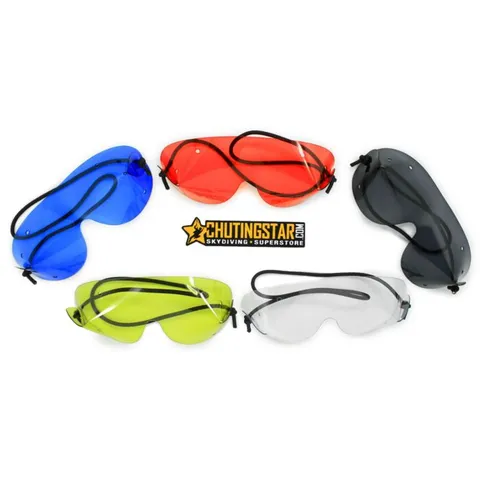
Students and anyone jumping in variable light should start with a clear lens so instructors can see your eyes and you can read instruments in any conditions. Tinted or smoke lenses are nice for bright midday loads, and mirrored/revo lenses add style and glare control for experienced jumpers. Many goggles are sold per-lens-color rather than with swappable lenses, so buy the tint you'll use most, or own two cheap pairs.

Treat them as consumables. Replace any goggle once the lens is scratched enough to distort vision, the foam seal compresses and stops sealing, or the strap loses elasticity. Because most quality jump goggles cost $15–$40, most experienced jumpers simply keep a fresh spare in the gear bag and rotate them every season or two rather than babying one pair.

Some links are affiliate links, and we may earn a commission at no extra cost to you. It never affects our rankings.

In your pocket

Take every dropzone with you.

Free, no account needed. Dropzone maps, gear checklists, and your jump log in your pocket.

  • Every dropzone in your pocket

  • Round up your crew with group chat

  • Your jump log in one timeline

  • Prep checklists synced to your account

The Skydiving Hubs app dashboard

For operators

Run a skydiving business?
Get on the map for free.

Claim your free listing for a branded page and a spot in the Skydiving Hubs app, then add bookings and digital waivers whenever you’re ready. No setup cost.